You've found your dream home, negotiated the price, and secured a solid mortgage rate. Then your lender hands you the closing disclosure and there it is: $8,000 to $15,000 in closing costs on top of your down payment.
It's one of the most common surprises in the homebuying process—and one of the first questions buyers ask: can you roll closing costs into your mortgage?
The short answer is yes, in most cases. But whether you should is a different question entirely. This guide breaks down exactly how it works, what it costs you over time, and when it genuinely makes financial sense.
What Are Closing Costs on a Mortgage?
Closing costs are the fees and expenses you pay to finalize your home loan. They typically range from 2% to 6% of the loan amount and cover everything from your lender's origination fee to the title search, appraisal, prepaid taxes, and homeowner's insurance.
On a $350,000 home purchase, you're looking at roughly $7,000 to $21,000 in closing costs—a wide range that depends on your location, loan type, and lender. Run your own numbers with our closing cost calculator.
3 Ways to Roll Closing Costs Into Your Mortgage
There isn't just one way to finance your closing costs. Depending on your loan type and situation, you have three primary options.
Option 1: Lender Credit (Higher Rate, Lower Upfront Cost)
This is the most common approach. Your lender offers you a lender credit to cover some or all of your closing costs in exchange for a slightly higher interest rate. You'll sometimes hear this called a 'no-closing-cost mortgage.'
For example, on a $350,000 loan:
- Standard rate: 5.75% with $10,000 in closing costs due at closing
- Lender credit option: 6.5% with $0 in closing costs due at closing
The 0.75% rate increase adds about $150 per month to your payment. Over 30 years, that's roughly $60K more in interest—or 600% more than original closing costs.
Option 2: Finance Into the Loan Balance (Refinances Only)
If you're refinancing, you can typically add closing costs directly to your new loan balance. This option is generally not available on purchase loans because the loan amount is tied to the purchase price and your appraisal value.
Option 3: Seller Concessions (Purchase Loans)
On a home purchase, you can negotiate for the seller to pay your closing costs. This is called a seller concession or seller credit. The seller doesn't write you a check—instead, the amount gets built into the purchase price.
When Rolling in Closing Costs Makes Financial Sense
Roll Them In When:
- You plan to move or refinance within 3–5 years: The lender credit's higher rate won't cost you more than paying upfront.
- You need to preserve cash for reserves: Lenders want to see 2–6 months of mortgage payments in the bank after closing.
- You're investing the savings elsewhere: If you'd earn a higher return investing that $10,000 than the additional interest costs.
- You're in a buyer's market with negotiation leverage: Seller concessions cost you nothing in rate or interest.
Pay Them Upfront When:
- You're staying in the home for 7+ years: Over a long holding period, even a small rate increase costs significantly more.
- You have the cash without straining your reserves: It's almost always the cheaper path.
- You want the lowest possible monthly payment: A lower rate means a lower payment for the life of the loan.
The Real Cost: A Side-by-Side Comparison
On a $350,000 home purchase with $10,000 in closing costs: taking a lender creadit at 6.50% costs $446,000 in total interest over 30 years. Taking no credit at 5.75% costs $385,000—that's an extra $61,000 over the life of the loan. The breakeven point is roughly 5 years.
Common Misconceptions About Closing Costs
'No-closing-cost mortgages are free'
There is no such thing as a free closing. When a lender advertises 'no closing costs,' they're financing them through a higher rate, a lender credit, or both. The costs still exist—they're just hidden in your rate.
'Closing costs are negotiable'
Some are, some aren't. Lender fees like origination charges are negotiable. Third-party fees like appraisals and title insurance are typically fixed. Your best leverage is shopping across multiple lenders.
'I can always add closing costs to my purchase loan balance'
This is the biggest misconception. On a purchase, you generally cannot simply add closing costs to the loan amount because the loan can't exceed the appraised value.
How It Works by Loan Type
Conventional Loans
Lender credits are widely available. Seller concessions are limited to 3–9% depending on your down payment. You cannot add closing costs to the loan balance on a purchase.
FHA Loans
FHA allows seller concessions up to 6%. The FHA also allows the lender, builder, or seller to pay closing costs including the upfront mortgage insurance premium. FHA streamline refinances allow closing costs to be rolled into the loan.
VA Loans
VA loans are unique. The seller can pay all of your loan-related closing costs plus up to 4% of the home price in concessions. The VA funding fee can be rolled into the loan.
USDA Loans
USDA allows financing up to 100% of the appraised value, meaning if the home appraises higher than the purchase price, the difference can be used to cover closing costs. Seller concessions up to 6% are also allowed.
Your 5-Step Decision Process
- Step 1: Get your full closing cost estimate from your lender (the Loan Estimate form), then check it against our closing cost calculator to see whether the numbers look reasonable for your loan size and location.
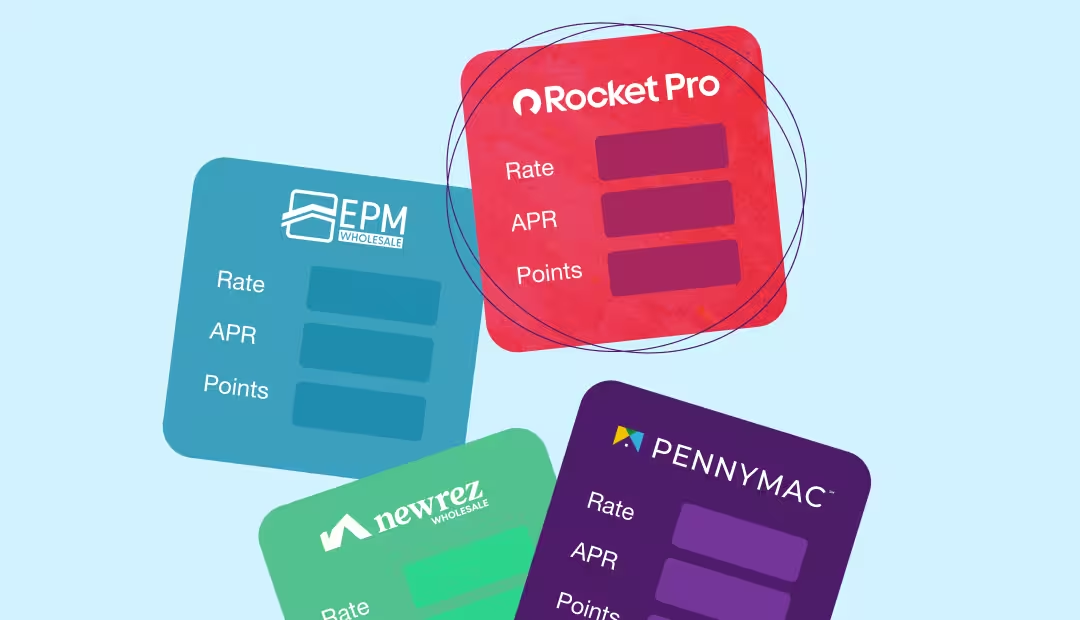
- Step 2: Ask your lender to show you the rate with and without a lender credit.
- Step 3: Calculate the breakeven period—divide total closing costs by the monthly payment difference.
- Step 4: Compare that to your expected time in the home.
- Step 5: If buying, explore seller concessions as a third option that doesn't affect your rate.
Frequently Asked Questions
Can you roll closing costs into a conventional loan?
On a purchase, you cannot add closing costs to the loan balance. You can use lender credits or negotiate seller concessions. On a refinance, you can typically finance closing costs into the new loan balance, subject to LTV limits.
How much does rolling in closing costs raise your rate?
Typically 0.125% to 0.375% depending on the amount of the credit and current market conditions. On a $350,000 loan, a 0.25% rate increase costs about $52 per month.
How much are closing costs on a $350,000 house?
Roughly $7,000 to $21,000, or 2% to 6% of the loan amount. The range depends on your state, loan type, and lender. Title and recording fees vary widely by county. Our closing cost calculator breaks the estimate down line by line.
Can I use gift funds for closing costs?
Yes, most loan types allow gift funds for closing costs. FHA, VA, and USDA loans are the most flexible. Gift funds need to be properly documented with a gift letter.
Are closing costs tax-deductible?
Some closing costs are deductible, including mortgage points, property taxes prepaid at closing, and mortgage interest. Other fees like the appraisal and title insurance are not deductible.
The Bottom Line
Rolling closing costs into your mortgage is a legitimate option that makes sense in specific situations—especially if you're planning to sell or refinance within a few years, or if preserving your cash reserves is a priority. But for borrowers staying long-term, paying upfront almost always wins the math. The key is running the numbers for your specific scenario, not following generic advice.
Related Reading on Altgage
- Closing Cost Calculator
- Mortgage Points Explained
- Waive Escrow on Your Mortgage: Save $10K at Closing
- How to Avoid PMI on Your Mortgage
- Get Your Rate