You’ve read the overview. You know a reverse mortgage lets homeowners 62 and older tap into home equity without monthly payments. But understanding the concept is one thing—understanding how the process actually works is what matters when you’re deciding whether to move forward. This guide walks you through every step of the reverse mortgage process: from the required counseling session to the final disbursement of funds. We’ll explain what happens at each stage, how long it takes, what documents you’ll need, and where the common pitfalls are. If you want a number to work from first, run your scenario through the reverse mortgage calculator.
The Reverse Mortgage Process: An Overview
The entire process typically takes 30 to 45 days from application to funding, though it can extend to 60 days depending on appraisal scheduling and underwriting complexity. Here’s the sequence at a high level:
- Complete HUD-approved counseling (required before application).
- Submit your application and authorize a financial assessment.
- Home appraisal by an FHA-approved appraiser.
- Underwriting review and loan approval.
- Closing and signing of loan documents.
- Three-day right of rescission (cooling-off period).
- Disbursement of funds according to your chosen payout option.
Each step has specific requirements, and skipping or rushing one can delay the entire timeline. Let’s break them down.
Step 1: HUD-Approved Counseling
Before any lender can accept your reverse mortgage application, you must complete a counseling session with a HUD-approved reverse mortgage counselor. This is a federal requirement—no exceptions.
The session typically lasts 60–90 minutes and can be conducted by phone or in person. The counselor will:
- Explain how reverse mortgages work, including all loan types (HECM, proprietary, HECM for Purchase).
- Review your specific financial situation and whether a reverse mortgage is appropriate.
- Walk through the costs, including upfront MIP, origination fees, and ongoing interest accrual.
- Discuss alternatives such as downsizing, HELOCs, or government assistance programs.
- Ensure you understand your obligations: property taxes, insurance, and home maintenance.
The counseling fee is approximately $125, and it’s often the only out-of-pocket cost before closing. After completing the session, the counselor issues a certificate that’s valid for 180 days. Your lender needs this certificate before processing your application.
Why this matters: Counseling isn’t just a checkbox. It’s the one step in the process designed entirely around your interests—not the lender’s. A good counselor will flag concerns you might not have considered and help you evaluate whether now is the right time to proceed. Our pros and cons guide covers the same ground so you arrive at counseling with informed questions.
Step 2: Application and Financial Assessment
With your counseling certificate in hand, you submit a formal application to your lender. This triggers the financial assessment—the lender’s evaluation of whether you can meet the ongoing obligations of the loan.
What the Financial Assessment Covers
Unlike a traditional mortgage, the financial assessment for a reverse mortgage isn’t about qualifying based on income. You’re not making monthly payments, so the lender doesn’t need to verify a debt-to-income ratio. Instead, they’re evaluating whether you can maintain the property and pay required charges going forward:
- Credit history: The lender reviews your credit report for patterns of delinquency on property taxes, insurance, or HOA fees. Past issues don’t automatically disqualify you, but they may trigger additional requirements.
- Income and expenses: Your lender reviews income sources (Social Security, pensions, investments) against ongoing obligations to confirm you can cover property charges.
- Property tax and insurance history: Consistent, on-time payment of property taxes and homeowners insurance is the strongest indicator of future compliance.
Life Expectancy Set-Aside (LESA)
If the financial assessment identifies risk—for example, a history of late property tax payments—the lender may require a Life Expectancy Set-Aside (LESA). This is a portion of your loan proceeds held in reserve specifically to pay property taxes and insurance on your behalf for the projected life of the loan.
A LESA reduces the amount of money available to you, but it protects you from defaulting on obligations and potentially losing the loan. It can be fully funded (mandatory payments made by the servicer) or partially funded, depending on the assessment results.
Documents You’ll Need
- Government-issued photo ID.
- Social Security card or proof of SSN.
- Proof of age (birth certificate or passport).
- Most recent property tax bill and proof of payment.
- Homeowners insurance declaration page.
- Any existing mortgage statements.
- Income documentation: Social Security award letters, pension statements, investment account statements.
- Bank statements (last 2–3 months).
Step 3: Home Appraisal
The lender orders an appraisal from an FHA-approved appraiser—not a standard appraisal, but one that meets FHA’s specific property condition requirements. This serves two purposes:
Determining market value: Your home’s appraised value (up to the 2026 HECM limit of $1,249,125) directly determines how much you can borrow. The higher the value, the more equity available to you.
Confirming property condition: FHA requires the home to meet minimum safety and livability standards. The appraiser will flag issues like:
- Peeling or chipping paint (especially on pre-1978 homes due to lead paint concerns).
- Roof damage or active leaks.
- Foundation issues or structural concerns.
- Non-functional systems (HVAC, plumbing, electrical).
- Health and safety hazards.
If the appraiser identifies required repairs, you have two options: complete the repairs before closing, or in some cases, set aside funds from the loan proceeds to cover them (called a repair set-aside). Minor cosmetic issues typically aren’t flagged.
Appraisal costs range from $400 to $600 depending on your market, and this can be financed into the loan.
Step 4: Underwriting and Approval
Once the appraisal is complete and all documentation is submitted, the loan goes to underwriting. The underwriter verifies everything: counseling certificate, financial assessment results, appraisal, title search, and compliance with FHA guidelines.
This stage typically takes 2–3 weeks. Common reasons for delays include:
- Missing or incomplete documentation (most frequent cause).
- Title issues such as liens, judgments, or unclear ownership.
- Appraisal repairs that need to be verified as complete.
- Additional conditions requested by the underwriter for clarification.
Once underwriting is satisfied, you receive a commitment letter—your official approval to proceed to closing.
Step 5: Closing
Closing on a reverse mortgage is similar to any other real estate closing. You’ll meet with a notary or closing agent (or close remotely, depending on your state) to sign the final loan documents.
Key documents you’ll sign include:
- The note: Your promise to repay the loan when it becomes due.
- The mortgage/deed of trust: Gives the lender a lien on your property as security for the loan.
- HUD-1/Closing Disclosure: Itemizes all costs, credits, and the net amount available to you.
- Right of rescission notice: Confirms your right to cancel within 3 business days after closing.
If you have an existing mortgage, it will be paid off from the reverse mortgage proceeds at closing. The remaining balance is what’s available to you.
Important: Bring your photo ID to closing. Review your Closing Disclosure carefully before signing—verify that the loan amount, interest rate, fees, and disbursement plan match what you were quoted. If anything looks wrong, ask questions before you sign.
Step 6: Right of Rescission
After closing, federal law gives you a 3-business-day right of rescission—a cooling-off period during which you can cancel the loan for any reason, no questions asked. This clock starts the day after closing and excludes Sundays and federal holidays.
If you close on a Monday, your rescission period runs Tuesday through Thursday. You can cancel by written notice to the lender. If you don’t cancel, the loan becomes final at midnight on the third business day.
This protection exists because of the significance of the transaction. Once the rescission period passes, the loan is binding and disbursement begins.
Step 7: Disbursement
After the rescission period expires, your funds are disbursed according to the payout option you selected during the application process. The reverse mortgage calculator models each of these against your home value and age:
Lump Sum
Available only on fixed-rate HECMs. You receive up to 60% of the principal limit at closing (the remaining 40% becomes available after 12 months). Best for borrowers who need to pay off an existing mortgage or cover a large immediate expense.
Line of Credit
The most popular option. Funds sit in an available credit line that you draw from as needed. The unused portion grows over time at the same rate as the loan’s interest charge plus the annual MIP. This growth feature is unique to HECMs and makes the line of credit increasingly valuable over time.
Monthly Payments (Tenure or Term)
Tenure payments continue for as long as you live in the home—even if you outlive the loan balance. Term payments last for a fixed period you choose. Both provide predictable income, but tenure is guaranteed for life while term offers larger monthly amounts over a shorter period.
Combination
Mix a line of credit with monthly payments for maximum flexibility. Many financial planners recommend this approach: use tenure payments for baseline expenses and the LOC for unexpected costs or market downturns. Our portfolio coordination calculator shows how drawing from the LOC during down markets affects how long an investment portfolio lasts.
How the Loan Balance Grows Over Time
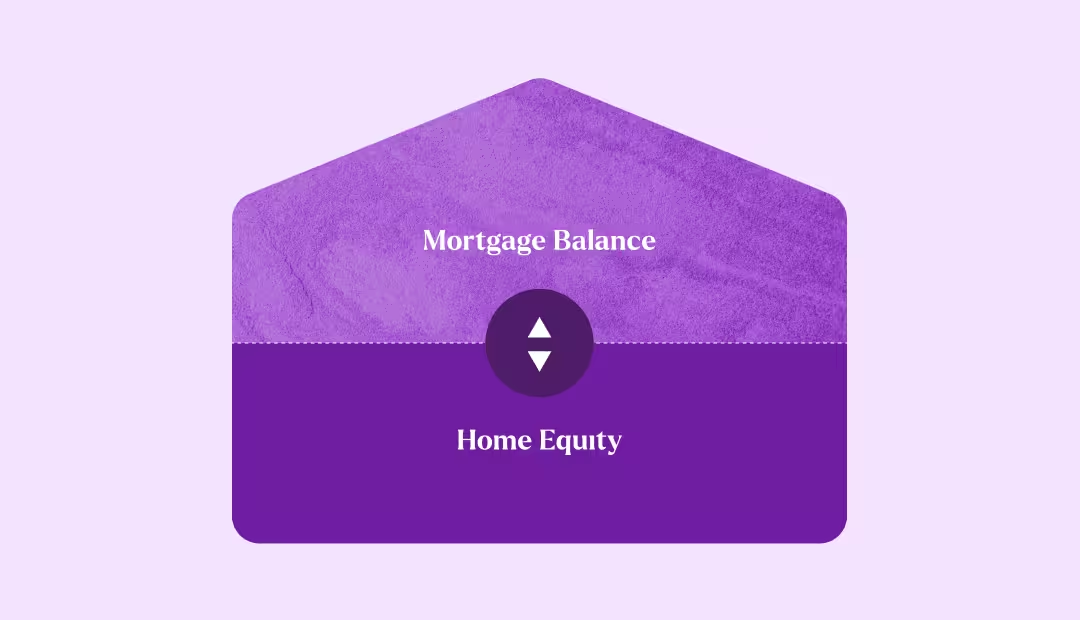
This is the aspect of reverse mortgages that surprises many borrowers: because you’re not making monthly payments, your loan balance increases over time as interest and fees accrue. Understanding this growth is essential to making an informed decision.
What Accrues on Your Balance
Interest: Charged on the outstanding balance. For adjustable-rate HECMs, this is based on a margin plus an index (typically the 1-year CMT). Fixed-rate HECMs lock in the rate at closing.
Annual MIP: 0.5% of the outstanding balance per year, charged monthly. This funds the FHA insurance that provides non-recourse protection.
Servicing fees: If applicable, up to $35/month (many lenders have eliminated separate servicing fees).
The compounding effect means your loan balance grows faster over time. However, two important protections limit your exposure:
Non-recourse protection: You and your heirs can never owe more than the home’s fair market value. If the loan balance exceeds the home value, FHA insurance covers the gap.
Home appreciation: In many markets, home values appreciate at 3–5% annually. This appreciation can partially or fully offset the growing loan balance, preserving equity for your heirs.
When the Loan Becomes Due
A reverse mortgage becomes due and payable when one of the following occurs:
- The last surviving borrower sells the home.
- The last surviving borrower moves out of the home as their primary residence for more than 12 consecutive months (including moving to assisted living).
- The last surviving borrower passes away.
- The borrower fails to meet loan obligations: property taxes, homeowners insurance, home maintenance, or HOA fees.
When the loan becomes due, the borrower or heirs typically have 6 months to repay the loan (with possible extensions up to 12 months). Repayment options include selling the home, refinancing into a forward mortgage, or paying the balance from other assets.
If the home is sold for more than the loan balance, the borrower or heirs keep the difference. If it’s sold for less, the FHA insurance covers the shortfall—no one owes the difference. This is the non-recourse guarantee.
Non-Borrowing Spouse Protection: If your spouse is under 62 and not listed as a borrower, current HUD rules allow them to remain in the home after the borrowing spouse passes away or moves to care, as long as certain conditions are met (they must have been married at loan origination and the home must remain their primary residence). The non-borrowing spouse cannot access additional loan proceeds, but they are protected from displacement.
Frequently Asked Questions
How long does the reverse mortgage process take?
Most reverse mortgages close within 30–45 days from application. The counseling session can be completed in 1–2 weeks, and underwriting typically takes 2–3 weeks after all documents and the appraisal are submitted. Delays are most commonly caused by appraisal scheduling, required repairs, or missing documentation.
Do I need good credit to get a reverse mortgage?
There is no minimum credit score requirement for a HECM. However, the financial assessment reviews your credit history for patterns of delinquency on property-related obligations. A history of late property tax or insurance payments may result in a Life Expectancy Set-Aside, which reduces your available proceeds.
Can I choose how I receive the money after closing?
You select your disbursement option during the application process. With adjustable-rate HECMs, you can change your payout option after closing (for example, switching from a line of credit to monthly payments) by contacting your servicer. Fixed-rate HECMs only offer lump sum disbursement.
What happens if my home needs repairs during the appraisal?
If the FHA appraiser identifies required repairs, you can complete them before closing or, in some cases, set aside funds from the loan proceeds to cover them post-closing. Cosmetic issues are generally not flagged. Structural or safety issues must be resolved.
Can I still get a reverse mortgage if I have an existing mortgage?
Yes. The reverse mortgage pays off your existing mortgage first from the proceeds. You need enough equity for the reverse mortgage to cover the existing balance and still provide meaningful funds. This is actually one of the most common use cases—eliminating a monthly mortgage payment in retirement.
What if I change my mind after closing?
You have a 3-business-day right of rescission after closing. During this period, you can cancel the loan for any reason by providing written notice to the lender. After the rescission period, the loan is final.
The Bottom Line
The reverse mortgage process is more structured than many borrowers expect—and that’s a good thing. The mandatory counseling, financial assessment, FHA appraisal, and right of rescission all exist to protect you. Each step ensures you’re making an informed decision about a significant financial transaction.
The key to a smooth process: start early, gather your documents upfront, and work with a lender who explains every step clearly. Delays happen most often when documentation is incomplete or when borrowers don’t understand what’s coming next.
At Altgage, we walk you through each step with full transparency—no surprises, no pressure. Start with a no-obligation conversation.
Related Reading on Altgage