If you’re researching reverse mortgages, you’ve probably encountered two extremes: lenders who present them as a risk-free retirement solution and critics who call them predatory traps. The truth is more nuanced—and your decision should be based on your specific financial situation, not on marketing or fear.
This guide presents the real advantages and real drawbacks of reverse mortgages, including specific scenarios where they’re a strong fit and situations where you should consider alternatives. We’re not here to sell you on a reverse mortgage—we’re here to help you decide. To put numbers against the trade-offs below, start with the reverse mortgage calculator.
The Pros: What a Reverse Mortgage Does Well
No Monthly Mortgage Payments
This is the headline benefit and the one that matters most to retirees on fixed incomes. A reverse mortgage eliminates your monthly mortgage payment entirely. If you’re currently paying $1,500–$2,500/month on a traditional mortgage, that’s $18,000–$30,000 per year returned to your cash flow.
You still must pay property taxes, homeowners insurance, and maintenance—but the mortgage payment itself is gone. For many retirees, this single change transforms their monthly budget.
You Stay in Your Home
You retain full ownership and the right to live in your home for as long as it remains your primary residence. The lender has a lien (just like any mortgage), but you’re on the title, you make all decisions about the property, and you can sell at any time. There is no scenario where the lender forces you out of your home as long as you meet your obligations.
Flexible Access to Funds
HECM reverse mortgages offer five disbursement options: lump sum, line of credit, tenure payments (lifetime), term payments (fixed period), and combinations. This flexibility means you can tailor the product to your specific needs—whether that’s paying off debt, supplementing monthly income, or building an emergency reserve.
The line of credit option is particularly powerful: unused funds grow over time at the loan’s interest rate plus the annual MIP. This means your available credit increases the longer you wait to use it—a feature no traditional HELOC offers.
Non-Recourse Protection
Neither you nor your heirs will ever owe more than the home’s fair market value at the time the loan is repaid. If the loan balance grows to $350,000 but the home is only worth $300,000, FHA insurance covers the $50,000 shortfall. Your heirs are never personally liable for the difference.
This protection eliminates the downside risk that worries most borrowers: the fear of “owing more than the house is worth.” It’s built into every HECM by federal law.
Tax-Efficient Income
Reverse mortgage proceeds are considered loan advances, not income. This means they’re generally not subject to federal income tax. Compare this to withdrawals from a traditional IRA or 401(k), which are taxed as ordinary income. For retirees managing tax brackets, reverse mortgage draws can be a strategically tax-efficient source of funds.
Reverse mortgage proceeds also don’t affect Social Security retirement benefits or Medicare premiums (though they can impact Medicaid eligibility if funds are left in a bank account past the end of the month).
Strategic Retirement Planning Tool
A growing body of academic research supports using reverse mortgage lines of credit as part of a coordinated withdrawal strategy: drawing from the LOC during years when your investment portfolio declines, giving your stocks and bonds time to recover. Multiple peer-reviewed studies show this approach can extend portfolio life by 5+ years and increase legacy wealth compared to the traditional approach of saving home equity as a last resort. Our portfolio coordination calculator lets you test this against your own portfolio and home value.
The Cons: What You Need to Know
Costs Are Higher Than Traditional Mortgages
Reverse mortgages carry significant upfront costs:
Upfront Mortgage Insurance Premium (MIP): 2% of the appraised value or HECM limit. On a $400,000 home, that’s $8,000
Origination fee: Up to $6,000 (varies by lender)
Closing costs: Appraisal, title, recording fees—typically $2,000–$4,000
Ongoing annual MIP: 0.5% of the outstanding balance per year
Most of these costs can be financed into the loan (so you don’t pay cash upfront), but they still reduce the proceeds available to you and accrue interest over the life of the loan. If you only plan to stay in your home for 2–3 years, the cost-per-year of a reverse mortgage may not make financial sense compared to alternatives.
Your Loan Balance Grows Over Time
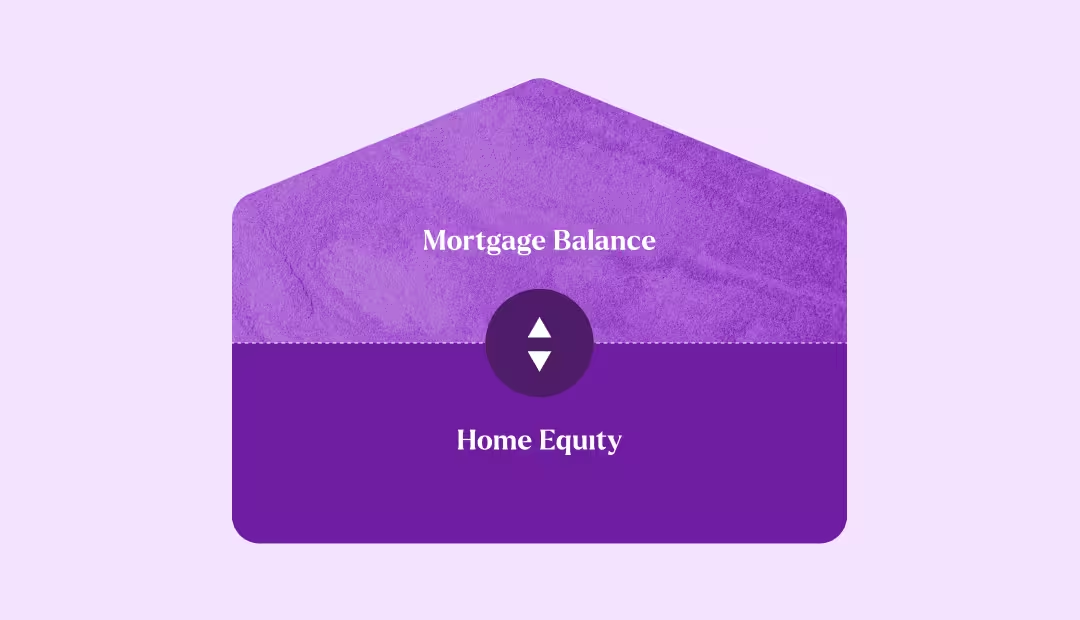
Because you’re not making payments, interest and MIP accrue on the outstanding balance. The loan balance compounds, meaning it grows faster over time. This reduces the equity available to you or your heirs when the loan is eventually repaid.
However, two factors mitigate this: home appreciation can offset the growing balance, and non-recourse protection ensures you never owe more than the home’s value. The net impact depends on how long you hold the loan and how your local real estate market performs.
Reduced Inheritance for Heirs
A reverse mortgage draws down your home equity. If leaving a fully paid-off house to your heirs is a priority, a reverse mortgage works against that goal. Your heirs will inherit the home subject to the loan balance—they can sell and keep the remaining equity, refinance to keep the home, or walk away with no liability.
This is often the most emotionally charged consideration. The counterargument: using home equity to fund a better quality of life in retirement is a legitimate choice, and many retirees find that their heirs prefer they live comfortably rather than protect an inheritance.
Ongoing Obligations Can Trip You Up
A reverse mortgage doesn’t eliminate all housing costs. You must continue paying:
- Property taxes (on time).
- Homeowners insurance (continuously).
- HOA fees (if applicable).
- Home maintenance (reasonable condition).
Failure to meet any of these obligations can trigger a loan default and potential foreclosure. If you’re already struggling to pay property taxes, a reverse mortgage may not solve the underlying problem—it just shifts the risk. The financial assessment is designed to catch this, but it’s important to be honest with yourself about your ability to maintain these costs.
Complexity and Misconceptions
Reverse mortgages are more complex than traditional mortgages, and this complexity creates room for misunderstanding. Borrowers sometimes don’t fully grasp how the loan balance grows, what triggers repayment, or how the product interacts with Medicaid planning. The mandatory counseling session helps, but the responsibility is ultimately on you to understand the terms.
Limits on Borrowing Amount
The HECM program caps borrowing at the lesser of your home’s value or $1,249,125 (in 2026). Even within that limit, you won’t access your full equity—the principal limit factor typically provides 40–70% of home value depending on your age and current rates. If you need to access more equity, you’ll need to consider a proprietary (jumbo) reverse mortgage, which has different terms and costs.
When a Reverse Mortgage Is a Good Fit
Based on the pros and cons above, here are the scenarios where a reverse mortgage typically makes strong financial sense:
- You plan to stay in your home for 5+ years. The upfront costs are amortized over time—the longer you stay, the more cost-effective the loan becomes.
- You have significant home equity and limited liquid retirement assets. If your wealth is concentrated in your home, a reverse mortgage unlocks it without requiring a sale.
- You need to eliminate a monthly mortgage payment. If you’re making $1,500–$2,500/month on a forward mortgage in retirement, a reverse mortgage can dramatically improve cash flow.
- You want a buffer against sequence of returns risk. The HECM line of credit provides a growing standby reserve that you can tap during market downturns instead of selling investments at a loss.
- You want to delay Social Security. Reverse mortgage proceeds can fund living expenses from 62 to 70 while your Social Security benefit grows by 6–8% per year.
When a Reverse Mortgage Is NOT a Good Fit
Equally important—here are situations where you should consider alternatives:
- You plan to move within 2–3 years. The upfront costs make a reverse mortgage expensive for short-term use. A HELOC or cash-out refinance may be more cost-effective.
- You can’t afford property taxes and insurance. A reverse mortgage doesn’t eliminate these costs, and failure to pay them can trigger default.
- Your home needs significant repairs you can’t fund. The FHA appraisal will require certain repairs, and deferred maintenance issues may persist after closing.
- Preserving full inheritance is your top priority. If passing the home to heirs with no debt is essential to your estate plan, a reverse mortgage works against that goal.
- You have sufficient liquid assets to fund retirement. If you have ample savings and investments, the costs of a reverse mortgage may not be justified. (Though establishing an LOC early as a standby reserve can still make strategic sense.)
Reverse Mortgage vs. Alternatives
A reverse mortgage isn’t your only option for accessing home equity in retirement. Here’s how it compares to the most common alternatives:
Reverse Mortgage vs. HELOC
Monthly payments: Reverse mortgage: none. HELOC: required (interest-only during draw period, fully amortizing during repayment)
Credit line stability: Reverse mortgage: cannot be frozen or reduced. HELOC: can be frozen or reduced at lender’s discretion
Upfront costs: Reverse mortgage: higher (MIP, origination). HELOC: lower (often no closing costs)
Age requirement: Reverse mortgage: 62+. HELOC: none
Best for: Reverse mortgage: long-term income supplementation. HELOC: short-term borrowing with the ability to make payments
For the full side-by-side, read our reverse mortgage vs. HELOC comparison or model both in the HELOC calculator.
Reverse Mortgage vs. Cash-Out Refinance
Monthly payments: Reverse mortgage: none. Cash-out refi: required
Income qualification: Reverse mortgage: no income-based DTI. Cash-out refi: must qualify based on income and DTI
Interest rate: Reverse mortgage: typically higher. Cash-out refi: typically lower
Best for: Reverse mortgage: retirees who can’t qualify for or don’t want monthly payments. Cash-out refi: borrowers with strong income who want the lowest rate
Our HELOC vs. cash-out calculator compares those two directly if you’re weighing them.
Reverse Mortgage vs. Downsizing
Stay in home: Reverse mortgage: yes. Downsizing: no
Upfront costs: Reverse mortgage: loan costs. Downsizing: moving, agent commissions (5–6%), potential capital gains
Access to equity: Reverse mortgage: partial (40–70%). Downsizing: full (minus transaction costs)
Best for: Reverse mortgage: homeowners attached to their home/community. Downsizing: homeowners ready for a lifestyle change
Frequently Asked Questions
Are reverse mortgages safe?
Yes, when you understand the terms. Modern HECMs are federally insured, require mandatory counseling, include non-recourse protection, and are subject to extensive regulation. The risk isn’t safety—it’s suitability. A reverse mortgage is safe but may not be the right tool for every homeowner.
Will a reverse mortgage affect my Social Security?
Reverse mortgage proceeds do not affect Social Security retirement benefits or Medicare. However, if you receive Supplemental Security Income (SSI) or Medicaid, unspent proceeds held in your bank account past the end of the month may count as assets and affect eligibility.
Can I sell my home if I have a reverse mortgage?
Yes. You can sell at any time. The reverse mortgage balance is paid off from the sale proceeds, and you keep any remaining equity. If the sale price exceeds the loan balance, the surplus is yours. If it’s less, FHA insurance covers the difference.
What happens to my spouse if I die?
If your spouse is a co-borrower on the reverse mortgage, nothing changes—they continue living in the home with the same terms. If your spouse is a non-borrowing spouse (under 62 at origination), HUD rules protect them from displacement as long as certain conditions are met, though they cannot access additional loan proceeds.
How much equity will I have left?
It depends on how much you borrow, how long you hold the loan, and how your home’s value changes. A borrower who draws minimally from a line of credit in an appreciating market may retain significant equity. A borrower who takes a large lump sum in a flat market may see equity erode substantially. The reverse mortgage calculator models these scenarios on your numbers.
Is the interest on a reverse mortgage tax-deductible?
Interest on a reverse mortgage may be deductible, but only when it’s actually paid—typically when the loan is repaid (at sale, refinance, or repayment). Consult a tax professional for your specific situation, as the rules depend on how the funds are used.
The Bottom Line
Reverse mortgages are a powerful financial tool—but like any tool, they work best when used for the right job. The pros are compelling: no monthly payments, flexible income access, non-recourse protection, and strategic retirement planning benefits. The cons are real: higher costs, a growing loan balance, reduced inheritance, and ongoing obligations.
The right question isn’t “are reverse mortgages good or bad?” It’s “is a reverse mortgage right for my specific situation?” That answer depends on your age, equity, financial goals, how long you plan to stay in your home, and what alternatives are available to you.
At Altgage, we believe in showing you the full picture: the numbers, the alternatives, and the trade-offs. We’ll help you compare a reverse mortgage against every other option—and if a reverse mortgage isn’t the best fit, we’ll tell you. Start with a 15 min conversation
Related Reading on Altgage
• Portfolio Coordination Calculator
• What Is a Reverse Mortgage? The Complete Guide
• How Does a Reverse Mortgage Work? Step-by-Step
• Reverse Mortgage vs HELOC: Which Is Better for You?
• Today's Rates → rates.altgage.com