Within a few hours of you saying "lock it," your loan becomes a derivative.
Not in a figurative sense. It gets recorded on a lender's balance sheet as a financial instrument, assigned a probability, bundled with thousands of others, and offset with a short position in a market that trades roughly $200 billion a day. Nobody tells you any of this, and none of it changes your rate.
But it explains everything about what your lock period costs, why a 90-day costs more than a 30-day, and why the lender cares so much whether you actually close.
Step 1: Your lock becomes an IRLC
The moment your rate is locked, the lender creates an Interest Rate Lock Commitment — an IRLC.
An IRLC is a promise to lend you a specific amount at a specific rate for a specific number of days. Under accounting rules it is classified as a derivative, and it is carried at fair value on the lender's books. Its value moves every day with the market.
Read it from the lender's side and the asymmetry is obvious. They are obligated. You are not. If rates rise, you close and they eat the loss. If rates fall, you can renegotiate or walk to a competitor, and they eat that loss too.
You are holding a free option. That is not an accident or an oversight — it is how the American mortgage market is built, and it is unusual globally. It is also the single thing the rest of this article is about, because someone has to pay for it.
Step 2: Your rate is not the rate investors buy
Here is where most explanations skip a step.
Your loan does not get sold at your note rate. It gets pooled into a mortgage-backed security, and securities trade in half-percent coupons — 5.0%, 5.5%, 6.0%. Your note rate has to be translated into one of them. The industry calls this coupon slotting.
Two things come out of your rate on the way there:
- A guarantee fee paid to Fannie Mae or Freddie Mac for insuring the credit risk
- A servicing fee retained by whoever collects your payment each month
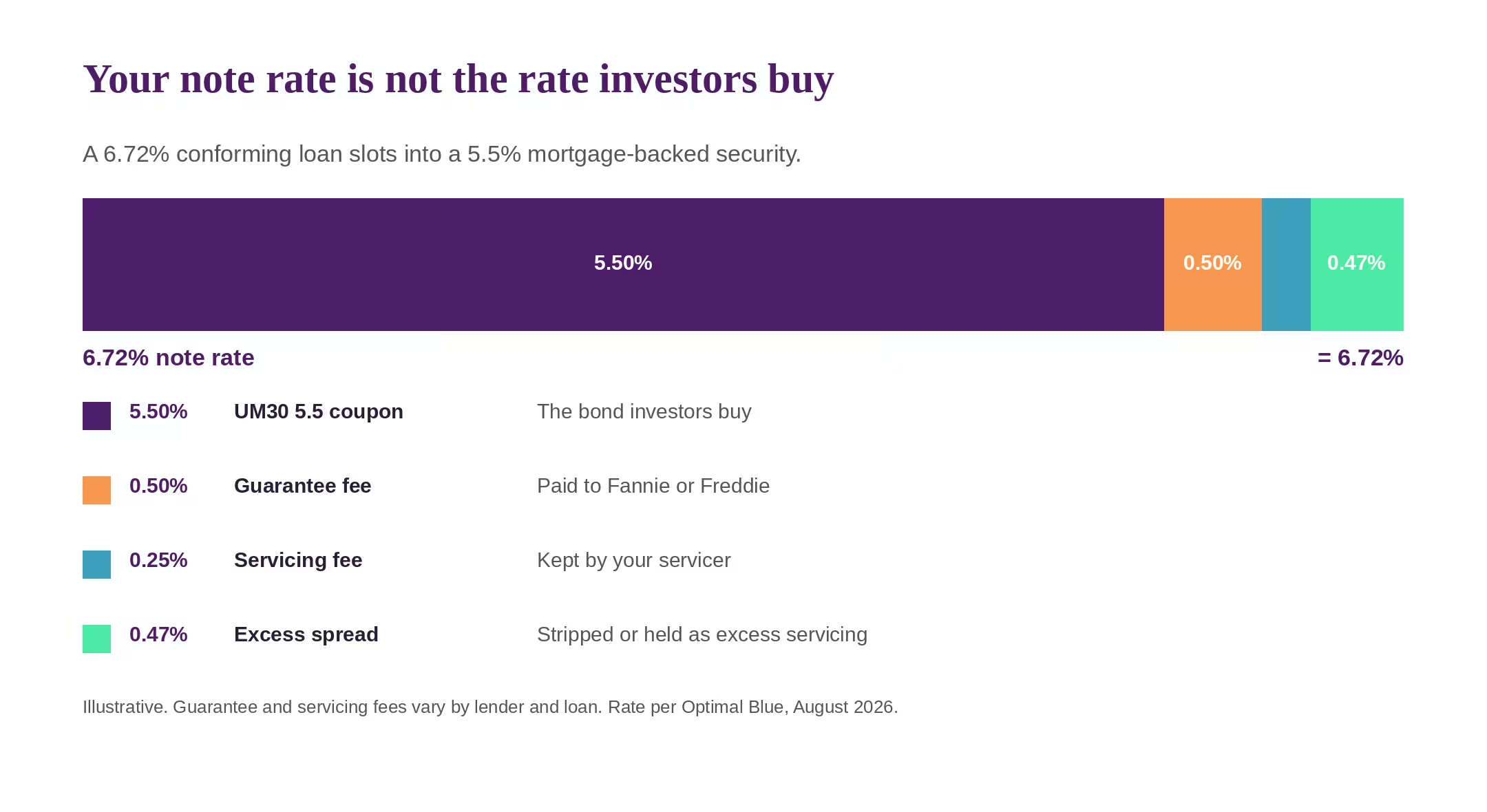
Optimal Blue's August 2026 Market Advantage report shows the 30-year conforming rate ending the month at 6.72%, with lenders concentrating their hedges in the UM30 5.5 — the 5.5% coupon for 30-year uniform MBS. That gap between what you pay and what the bond pays is not a markup. It is the plumbing.
This matters for one reason: the lender cannot hedge your loan directly, because your loan does not exist yet and no one trades individual mortgages. They hedge the security your loan will eventually become.
Step 3: The hedge
The lender sells forward into the TBA market.
TBA stands for "to be announced." Buyers agree to purchase mortgage-backed securities at a set price on a future date, without knowing which specific loans will be inside. They know the type, the term, and the coupon. That is enough.
That structure is the reason American mortgage rates can be quoted at all before a loan exists. It is also the reason you can lock a rate for 60 days, which borrowers in most countries cannot do.
The mechanics are simple once the pieces are named. The lender sells the coupon short. If rates rise, your loan is worth less when it sells, and the short position gains by roughly the same amount. If rates fall, the loan gains and the short loses. Either way the lender's margin survives, which is the entire point. Hedging is not a bet on rates. It is a refusal to make one.
Step 4: Pull-through, the number that makes it hard
Here is the problem with hedging something that might not happen.
If the lender hedges 100% of a pipeline and only 80% of it closes, they are over-hedged. The short position on the missing 20% has no loan behind it, and it is a naked directional bet the lender never intended to take.
So lenders forecast a pull-through rate: the share of locked loans that actually fund. They hedge that fraction, not the whole pipeline.
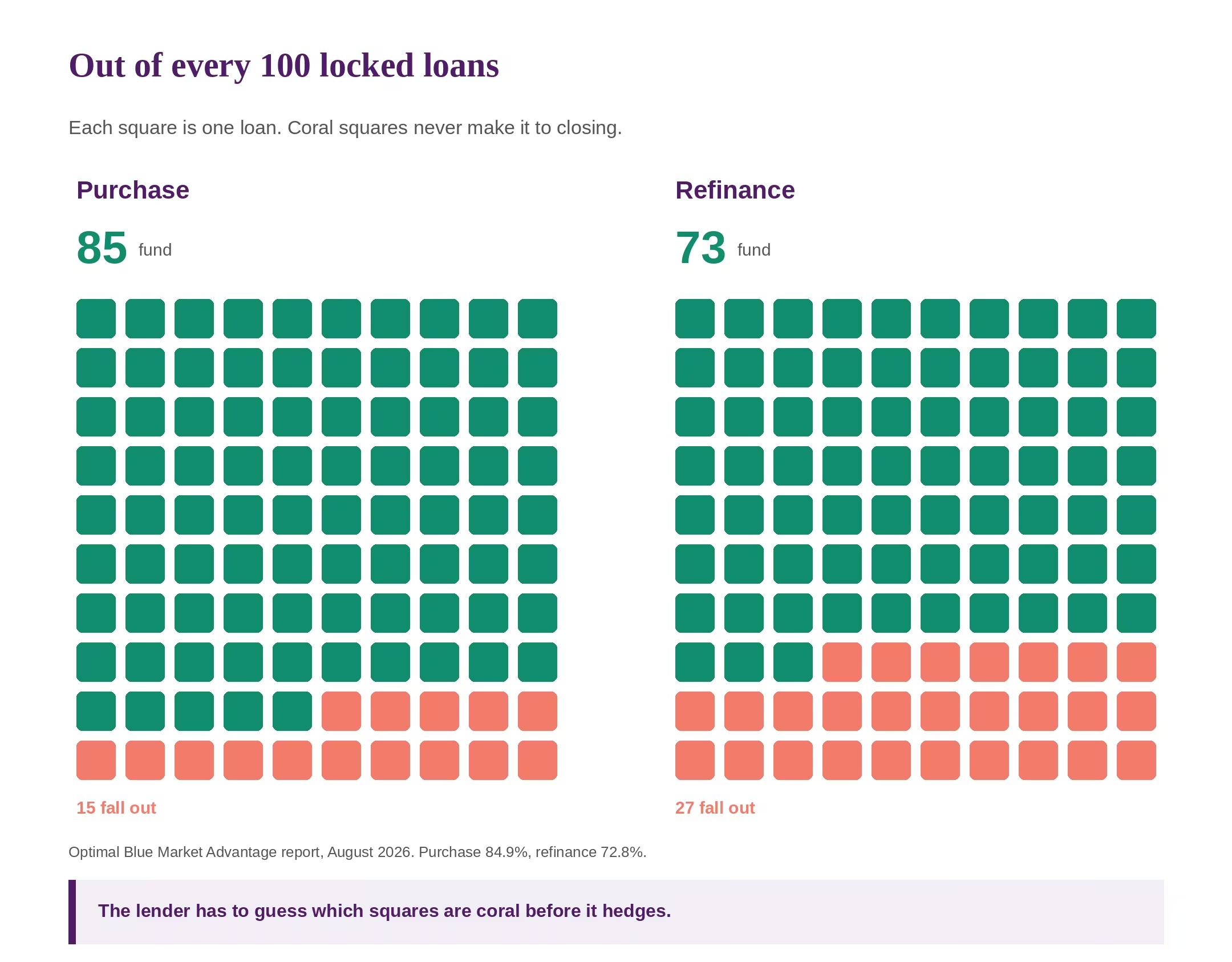
Two things are worth noticing in those numbers.
Refinances fall out far more often than purchases. A purchase has a seller, a contract, a closing date, and earnest money on the line. A refinance has none of that. Nothing stops a refinance borrower from walking except inertia, which is why refi pull-through runs about twelve points below purchase.
Pull-through is not stable. Optimal Blue's report shows purchase pull-through jumping six percentage points in a single month. A number that moves that much is a hard number to hedge against.
This is also the honest answer to why refinance pricing sometimes carries different adjusters than purchase pricing on the same day. It is not a penalty. It is a probability.
So why does a 90-day lock cost more?
Now the answer is mechanical rather than mysterious.
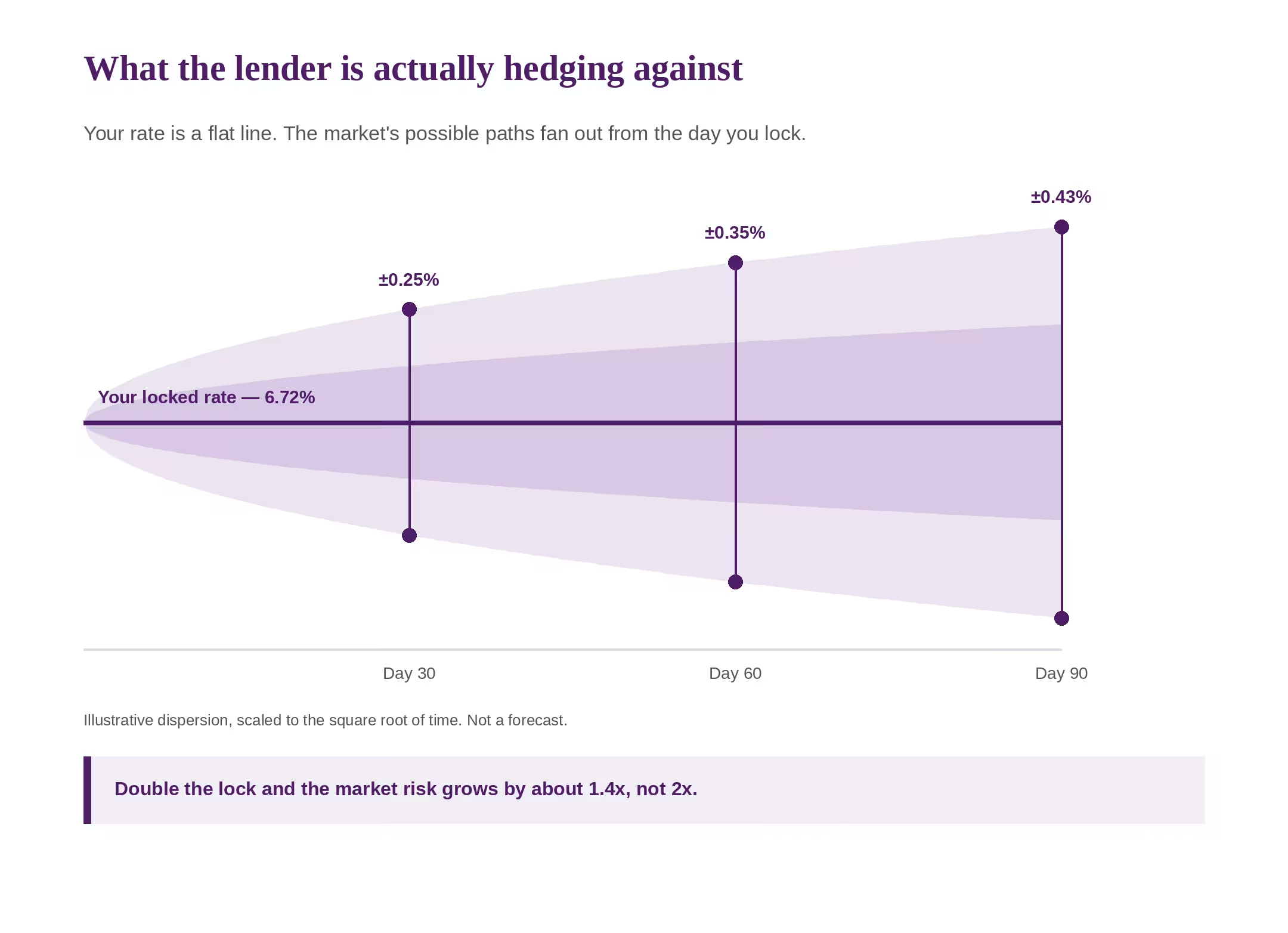
You are not paying for days. You are paying for the uncertainty those days create — and the amount of uncertainty is not linear, which is why the adjusters get steeper at the long end.
Fallout, and the thing lenders actually fear
Fallout is a locked loan that does not close. Some of it is ordinary: the inspection fails, the appraisal comes in low, the borrower's job changes.
The expensive kind is correlated fallout. When rates drop sharply, a large share of the pipeline wants out at the same moment — and that is exactly when the lender's short position is losing money. The hedge loses and the loans disappear together.
Lenders manage this in three ways, and all three are visible to you as a borrower if you know to look:
Lock desk policy. Many lenders will not let you lock until the file has reached a certain stage. That is not bureaucracy. Locking later raises pull-through.
Renegotiation policy. Most lenders will improve your rate if the market moves enough, because losing the loan entirely costs more than giving back part of the margin. The threshold is usually meaningful — a quarter point gets a conversation, five basis points does not.
Pricing. Whatever fallout costs on average gets built into the rate sheet. Everyone pays a share of it, including the borrowers who never renegotiate anything.
That last point is worth sitting with. The free option you hold is not free to the system. It is priced into every loan, every day, whether or not you use it.
Best efforts versus mandatory, and why it is in your rate
Not every lender hedges its own pipeline. There are two ways to sell a loan.
Best efforts: the lender commits to deliver the loan if it closes. The investor carries the fallout risk and prices for it.
Mandatory: the lender commits to deliver regardless, hedges its own pipeline, and keeps the difference.
The difference is measurable. Optimal Blue reported the best-efforts-to-mandatory spread for conventional 30-year products at 26 basis points in August 2026, down four basis points from July. Best efforts has also nearly disappeared as an execution channel, accounting for about 2% of volume.
Translated: a lender running a real hedging operation captures roughly a quarter point more on every loan than one that does not. Some of that shows up in your pricing. It is one of several reasons two lenders quoting the same day can be meaningfully apart.
Who actually hedges your loan, if you use a broker
Worth being direct about this, because it affects how you should read everything above.
Altgage is a mortgage broker. When we lock your rate, the lock is placed with a wholesale lender. That lender holds the IRLC, runs the hedge, and carries the risk. We do not hedge pipelines, and we are not paid more or less depending on which lock period you choose — broker compensation is a fixed percentage of the loan amount, set in advance and identical across lock lengths.
Which means the incentive that could distort this advice does not exist here. We have no reason to push you toward a 30-day you will blow through or a 90-day you do not need.
What we do have is visibility into several lenders' lock pricing on the same file at the same time. Lock adjusters are not standardized. A lender with a strong hedging desk and high pull-through can offer a 60-day at a price another lender charges for a 45.
What this actually means for you
Four things fall out of all of this.
Your closing date is worth more than your negotiating. Pull-through drives pricing. A file that closes on time, with documents in early and no surprises, is worth real money to the lender — and the lenders with the best pricing are usually the ones with the best pull-through, which is not a coincidence.
Do not shop a locked loan casually. Every borrower who walks after locking raises the average cost of fallout, which shows up in everyone's rate sheet. Shop hard before you lock, and compress it into a two-week window so it counts as one credit inquiry.
Ask for a renegotiation instead of assuming there is none. Most lenders have a policy. Few advertise it. If the market has moved a quarter point or more since you locked, the question is worth asking.
The longer lock is insurance, and insurance is priced on probability. If your file has a real chance of running long, the adjuster is cheaper than the extension schedule.
Frequently asked questions
What is an IRLC?
An Interest Rate Lock Commitment. It is the lender's binding promise to honor your rate for a set period, recorded as a derivative on their balance sheet and revalued daily. You are not bound by it — only the lender is.
What is the TBA market?
A forward market where investors buy mortgage-backed securities before the underlying loans exist, agreeing on type, term, and coupon rather than specific loans. It is what allows American lenders to quote and lock rates on loans that have not closed.
What is a pull-through rate?
The share of locked loans that actually fund. Optimal Blue reported purchase pull-through at 84.9% and refinance pull-through at 72.8% in August 2026. Lenders hedge to this number rather than to the full pipeline.
Why is my rate higher than the MBS coupon?
Your note rate covers the bond coupon plus a guarantee fee to Fannie Mae or Freddie Mac and a servicing fee to whoever collects your payments. The difference is structural, not a markup by your lender.
Does the lender lose money if I walk after locking?
Often yes. They hold a hedge against a loan that no longer exists. That cost gets built into pricing for everyone, which is why lock desk policies and renegotiation thresholds exist.
Can I ask my lender whether they hedge?
You can, and a capital markets desk will answer. Practically, the more useful questions are what their lock extension policy costs and whether they renegotiate on market moves. Those two answers tell you more about your actual outcome.
The bottom line
A rate lock looks like a promise and works like an option. You hold it for free. The lender hedges against it in a forward market, guesses at how likely you are to close, and prices the difference into the rate sheet.
None of that requires your attention on a Tuesday. But it does explain the one thing worth acting on: lock length is priced on uncertainty, and you control more of that uncertainty than you think. A clean file that closes on schedule is the cheapest loan in the pipeline, and the lender knows it before you do.
Related reading
- Should you lock your mortgage rate? What each lock period costs
- Mortgage points explained: what you're actually buying
- How long does mortgage preapproval last?
- What is a non-QM loan?
Market data cited from Optimal Blue's August 2026 Market Advantage report. Altgage Inc. NMLS #2447252. This is educational content, not financial advice. Rates and pricing change daily. Check rates.altgage.com for current pricing.