.avif)
Your loan officer asks whether you want to lock. You say yes or no in about four seconds, and nobody tells you what you just bought.
Here is what you bought: a one-sided option. If rates rise, your rate is protected. If rates fall, you can usually renegotiate or walk to another lender. You hold that option for free, and it is worth real money. That is why lock periods are priced, why longer ones cost more, and why the "free 30-day lock" is not free — it is simply the price everyone is quoted from.
This article covers what each lock period costs and how to choose one. If you want the basic mechanics first, start with what a mortgage rate lock is and how it works.
What a rate lock actually is
A rate lock is a lender's commitment to honor a specific interest rate and price for a specific number of days, usually 15, 30, 45, 60, 75, or 90.
Two things it is not.
It is not an approval. You still have to document income and assets, get an appraisal, and clear conditions. A lock protects pricing, not eligibility.
It is not a contract you are trapped in. You can cancel or switch lenders. You lose the locked rate, and you may lose an appraisal fee, but there is no penalty for walking.
Inside the industry this is called an Interest Rate Lock Commitment, or IRLC. It is carried on the lender's books as a derivative, because that is what it is.
What each lock period costs
Lock pricing is expressed in points — the same unit as discount points and lender credits. One point is 1% of the loan amount.
The 30-day price is the benchmark. Everything else is measured against it.
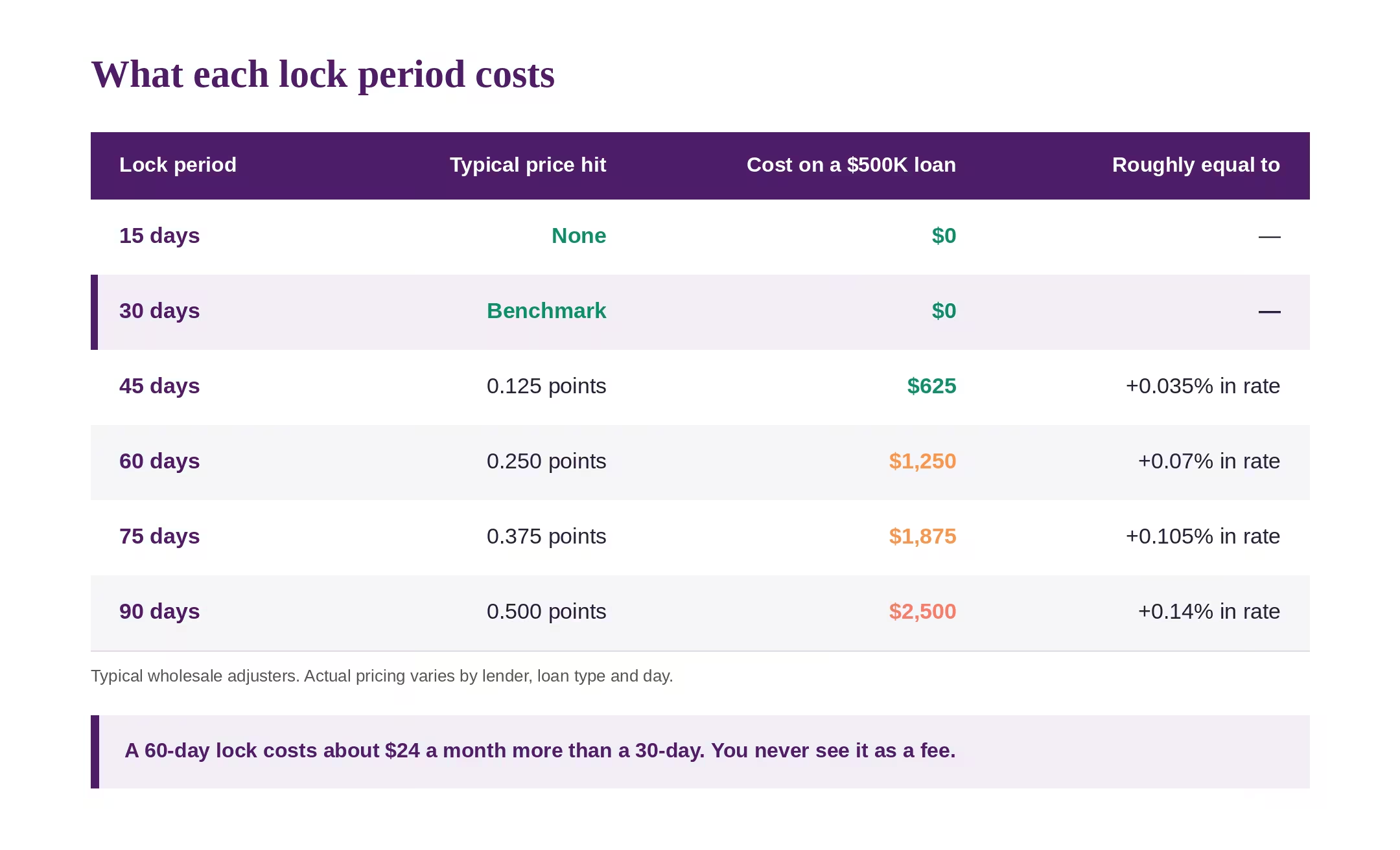
Three things worth pulling out of that table.
A 15-day lock usually buys you nothing. On most rate sheets 15 and 30 price identically. There is no reward for a tight timeline, only risk if you miss it. Take the 30.
You almost never write a check for this. The adjustment comes out of price, and price gets absorbed into your rate. On a $500,000 loan at an illustrative 6.50%, a 60-day lock runs about $24 a month more than a 30-day. A 90-day runs about $46 a month more. You will not see a "lock fee" line on your Loan Estimate. Our mortgage points calculator converts points into monthly dollars on your own loan amount.
It is cheaper than an eighth of rate. At current pricing, one eighth of rate (0.125%) costs roughly 0.40 to 0.45 points. So a 60-day lock costs a little over half an eighth. That is the real scale of this decision — smaller than most borrowers fear, and smaller than one round of extensions.
The extension math, which is the part that matters
This is where the money actually moves.
If your lock expires before you close, you extend. Extensions typically run 0.125 points per 7 days, sometimes more in a volatile market. Some lenders also re-price you at the worse of your locked rate or current market, which can hurt far more than the extension fee itself.
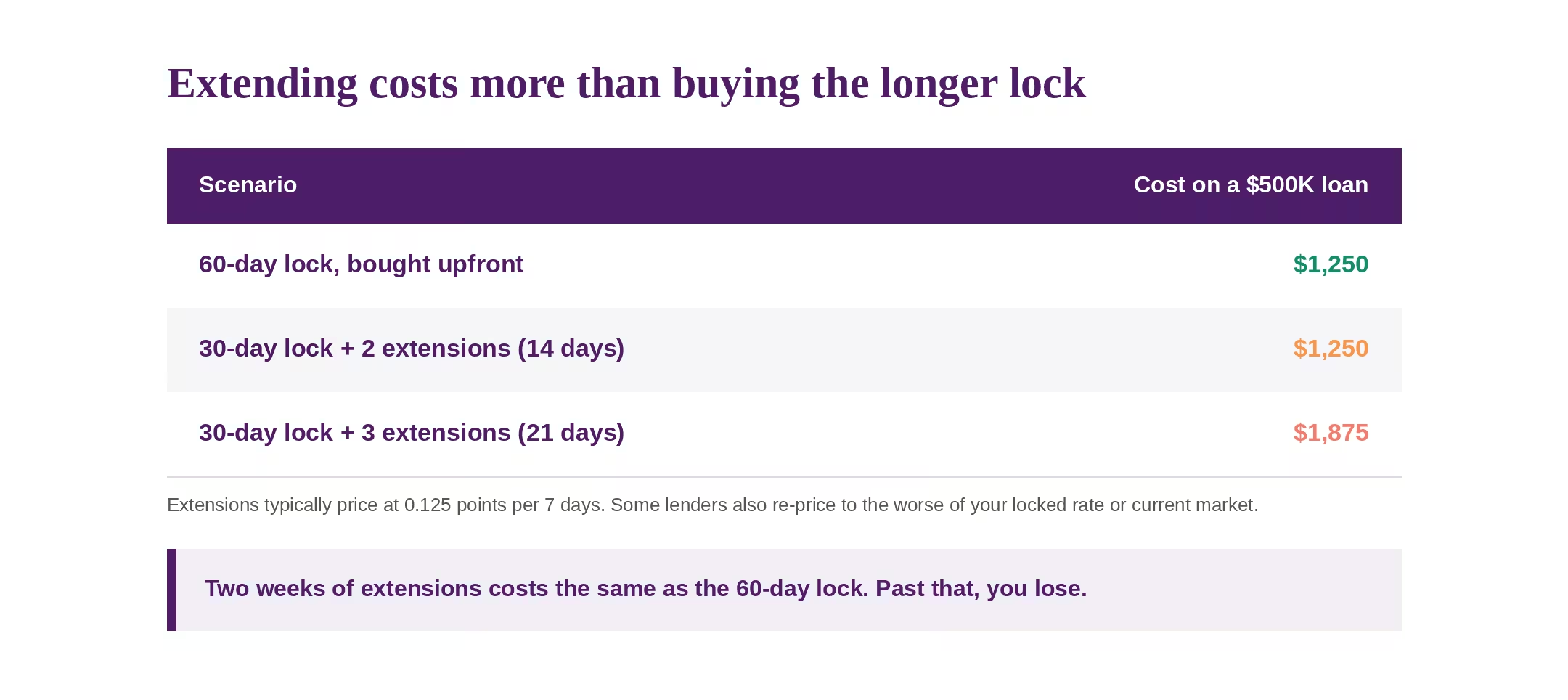
The 60-day lock and two weeks of extensions cost the same. Everything past two weeks is a loss.
The rule: if there is better than a coin-flip chance you will need two extra weeks, buy the longer lock at the start. New construction, co-op approvals, probate sales, self-employed borrowers with complex income, and any file waiting on a third party are all candidates.
The Altgage approach: We absorb the cost of a first 15-day extension on most files, so a short delay does not cost you anything. Ask how your specific file is priced.
When to lock: three factors
Your closing date
This is the dominant factor. Everything else is secondary.
- Under contract with a firm date inside 30 days: lock now, 30-day.
- Under contract, 30 to 45 days out: lock now, 45-day. The 0.125 is cheap insurance.
- Under contract, 45+ days out, or the date is soft: lock 60. Revisit if the file moves faster than expected.
- No accepted offer yet: you generally cannot lock. Most lenders require a property address.
For what happens between an accepted offer and closing day, see our contract to close checklist.
What a move against you actually costs
Run the number instead of guessing at it.
On a $500,000 loan, a 0.25% move against you is about $83 a month, or roughly $29,700 over a full 30-year term. On a $350,000 loan, the same move is about $58 a month, or roughly $20,800.
If that number would change what house you can buy, lock. If it would not, you have room to think about it. If you are losing sleep either way, lock — certainty has value and you are allowed to buy it. Check what payment your income supports in our affordability calculator.
The rate environment
Nobody reliably calls the direction of rates, including us. Two things are knowable anyway.
Volatility is observable even when direction is not. When the market is moving 0.125% in a day, the case for locking gets stronger regardless of which way you think it is heading, because the size of the possible move has grown.
Calendar risk is knowable. CPI releases, jobs reports, and Fed meetings all have published dates. If your closing window straddles three of them, you are holding more risk than a borrower whose window is quiet. That is an argument for a longer lock, not a shorter one. Our guide to the 5 factors that affect mortgage rates covers what actually moves pricing.
What happens the moment you lock
When your rate is locked, your loan does not sit in a drawer. It enters the lender's pipeline, and within hours it is hedged.
The lender sells forward into the TBA market — a market where investors buy mortgage-backed securities before the underlying loans exist. If rates rise and your loan loses value, the lender's short position gains, and the margin survives. That is the whole mechanism.
The complication is that not every locked loan closes. Lenders track a pull-through rate, the share of locks that become funded loans, and hedge only that fraction. Longer locks have lower and less predictable pull-through, which is the actual reason a 90-day costs more than a 30-day. You are not paying for time. You are paying for the uncertainty your time creates.
Four mistakes worth avoiding
Locking too short to save 0.125. You are risking two extension fees to save one. The math above says this loses more often than it wins.
Waiting for a better rate. Rates move daily. Timing the low is the same problem as timing a stock, with a closing date attached. If the payment works today, that is the decision you actually have to make.
Assuming you get 45 days to shop. This one is widely repeated and wrong. FICO's newer scoring models group mortgage inquiries inside a 45-day window, but mortgage lenders pull FICO 2, 4, and 5 — older models, and at least one of them uses a 14-day window. Compress your rate shopping into two weeks and you are covered under every model. Spread it over six and you may collect separate inquiries. Separately, FICO ignores mortgage inquiries from the 30 days before scoring, so recent pulls do not hit your score immediately.
Paying for a float-down. A float-down lets you capture a lower rate after locking, usually for a fee or a worse starting rate. We think most borrowers should decline it. The short version: you already hold a free option to renegotiate or leave, and the float-down sells you a narrower version of something you partly have.
Frequently asked questions
How long can you lock a mortgage rate?Most lenders offer 15 to 90 days. Longer locks up to 180 or 360 days exist for new construction, priced considerably higher. The standard choices are 30, 45, and 60.
Does a rate lock cost money?Usually not as a separate fee. The cost is built into your price, which shows up in your rate. A 60-day lock typically prices about 0.25 points worse than a 30-day, which is about $24 a month on a $500,000 loan.
What happens if my rate lock expires?You extend it, typically at about 0.125 points per week, or you re-lock at current market. If rates rose while you were locked, a re-lock means a higher rate. Some lenders re-price expired locks at the worse of the two, so ask before you let one lapse.
Can I still get a lower rate after I lock?Sometimes. If the market drops significantly, many lenders will renegotiate rather than lose the loan. There is no guarantee, and the threshold is usually meaningful. A 0.25% move gets attention. A 0.05% move does not.
Should I lock when refinancing?The same framework applies with one change. Refinances have no seller and no contract deadline, so your timeline is more flexible and your fallout risk is higher. Lenders know this, which is why refinance pricing sometimes carries a different adjuster. Run the numbers in our refinance breakeven calculator.
Is it better to lock at application or after approval?Most borrowers lock at or shortly after application, once they have a purchase contract with a closing date. Locking later shortens your exposure but leaves you at the mercy of whatever the market does in between.
The bottom line
Lock length is a small, cheap decision that people treat as a large one. Extension fees are a large decision that people treat as an afterthought. A 60-day lock costs about a quarter point. Three weeks of extensions costs more than that, plus the risk of being re-priced.
Match the lock to the closing date you actually expect, not the one on the contract. If the file has any reason to move slowly, buy the extra days upfront.
And if the rate works for your budget today, lock it. A rate that fits your plan is worth more than a rate you might have gotten.
See today's rates → or get pre-approved.