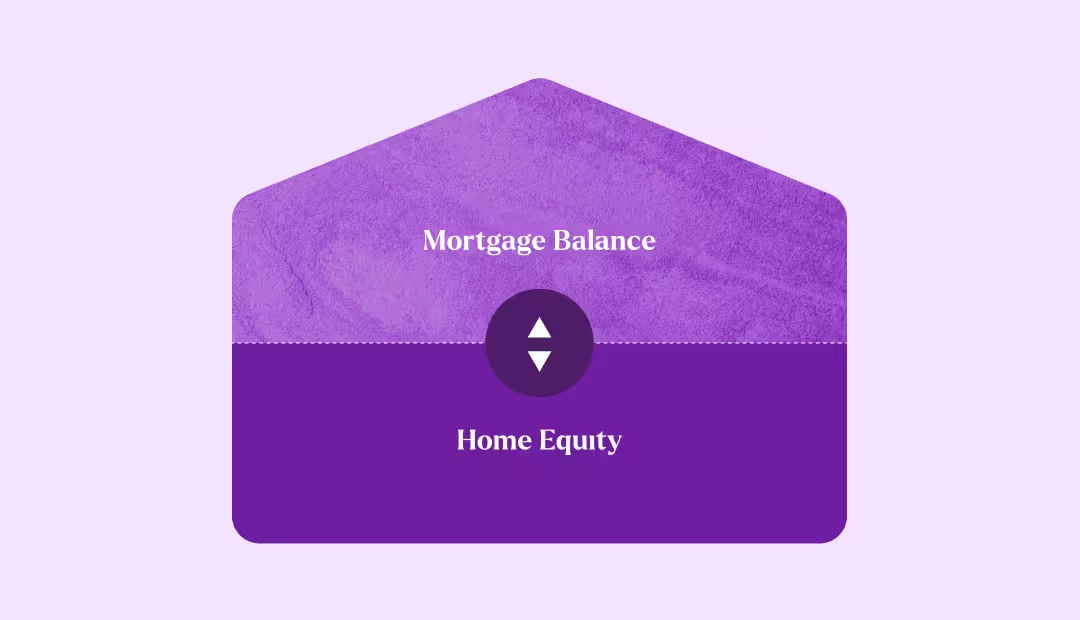
Both a reverse mortgage and a home equity line of credit (HELOC) let you access the equity in your home without selling it. They’re the two most common equity-access tools for homeowners 62 and older—and they get confused constantly.
But they work in fundamentally different ways, carry different risks, and are suited for different situations. Choosing the wrong one can cost you thousands in unnecessary interest or leave you exposed to risks you didn’t anticipate.
This guide compares them head to head: how each works, what they cost, and which one makes sense based on your specific financial situation. If you want to run the numbers alongside it, use the reverse mortgage calculator and the HELOC calculator.
How a HELOC Works
A home equity line of credit (HELOC) is a revolving credit line secured by your home. It works similarly to a credit card: you’re approved for a maximum borrowing amount and can draw funds as needed during a set period (the draw period, typically 10 years). After the draw period, you enter the repayment period (typically 10–20 years) and can no longer borrow.
During the draw period, most HELOCs require interest-only payments. When the repayment period begins, your payment jumps to include principal—often catching borrowers off guard. This “payment shock” is one of the most common problems with HELOCs held into retirement.
Key HELOC Features
Monthly payments: Required. Interest-only during draw period; principal + interest during repayment
Interest rate: Usually variable, tied to the prime rate. As of early 2026, prime is 7.5%, making most HELOC rates 7.5–8.5%
Income qualification: Yes—you must qualify based on income and DTI ratio
Credit score: Typically 680+ for best rates; 620 minimum at most lenders
Age requirement: None (18+ to sign)
Upfront costs: Low—many HELOCs have no closing costs or annual fees
Credit line stability: Lender can freeze or reduce your line at any time based on market conditions, home value changes, or their own risk assessment
How a Reverse Mortgage Works
A reverse mortgage (HECM) converts your home equity into loan proceeds—either as a lump sum, line of credit, monthly payments, or a combination. You don’t make monthly payments. Interest and fees accrue on the balance, and the loan is repaid when you leave the home (sell, move, or pass away).
The HECM program is insured by the FHA, which provides two critical protections: the lender cannot freeze or reduce your credit line, and the loan is non-recourse—meaning neither you nor your heirs can ever owe more than the home’s fair market value.
Key Reverse Mortgage Features
Monthly payments: None required. You must maintain property taxes, insurance, and home upkeep
Interest rate: Fixed or adjustable (margin + index, typically 1-year CMT). Current adjustable rates range from mid-5% to mid-7%
Income qualification: No DTI ratio required. Financial assessment checks ability to maintain property taxes and insurance
Credit score: No minimum score requirement for HECMs
Age requirement: 62+ (primary borrower). Some proprietary products available at 55+
Upfront costs: Higher—includes 2% upfront MIP, origination fee (up to $6,000), and standard closing costs
Credit line stability: Cannot be frozen or reduced by the lender under any circumstances—guaranteed by FHA insurance
Head-to-Head Comparison
Here’s how the two products compare on the factors that matter most to homeowners evaluating their options:
Monthly Payment Obligation
This is the most important difference and the one that drives most decisions. A HELOC requires monthly payments from day one—interest-only during the draw period, then fully amortizing during repayment. If your income drops or you face unexpected expenses, you’re still obligated to make those payments. Missing them puts your home at risk of foreclosure.
A reverse mortgage requires no monthly mortgage payments. You must maintain property taxes, insurance, and the home—but the loan itself has no payment due until you leave the home. For retirees on fixed incomes, this distinction is often the deciding factor. The certainty of no monthly payment obligation provides significant peace of mind and budget stability.
Credit Line Security
This is where HELOCs carry a risk that most borrowers underestimate. Your lender can freeze or reduce your HELOC at any time if your home value declines, your credit deteriorates, or the lender changes its risk appetite. This happened on a massive scale during the 2008–2010 financial crisis—millions of homeowners had their HELOCs frozen precisely when they needed them most.
A reverse mortgage line of credit cannot be frozen or reduced once established—regardless of changes in your home’s value, your credit, or market conditions. This is guaranteed by the FHA insurance. For a retirement safety net, this guarantee is significant: the funds will be there when you need them, even during a housing downturn or financial crisis.
How the Credit Line Grows
HELOC credit lines don’t grow. Your approved maximum is fixed at origination, and it only decreases as you draw against it.
A reverse mortgage line of credit’s unused portion grows at the same rate as the loan’s interest charge plus the annual MIP (0.5%). For example, a $200,000 available credit line at a 6.5% growth rate would grow to approximately $274,000 in 5 years and $376,000 in 10 years—without drawing a dollar. The reverse mortgage calculator models this growth on your own numbers. This growth feature is unique to the HECM program and is one of the primary reasons financial planners recommend establishing a reverse mortgage LOC early in retirement, even if you don’t need the funds immediately.
The math is compelling: the longer you wait to use the line, the more you have available. This creates a natural incentive to use the LOC strategically rather than immediately—which is exactly how financial planners recommend incorporating it into retirement income plans.
Total Costs Over Time
HELOCs are cheaper upfront. Many have no closing costs, and the interest rate is often lower than a reverse mortgage. However, HELOCs require ongoing monthly payments that represent a real cash-flow cost throughout the life of the product.
Reverse mortgages carry higher upfront costs: the 2% upfront MIP ($8,000 on a $400,000 home), an origination fee (up to $6,000), and standard closing costs ($2,000–$4,000). Most of these can be financed into the loan, so out-of-pocket costs are minimal.
The total cost comparison depends on how long you hold the product and how much you borrow. For short-term borrowing (1–3 years), a HELOC is almost always cheaper. For long-term access (5+ years), the reverse mortgage’s guarantees and growth features often outweigh the higher costs—especially when you factor in the value of no monthly payments and unfreezing credit line protection.
Income and Credit Requirements
HELOCs require income verification and a satisfactory debt-to-income ratio—the same qualification standards as any other loan. If you’re retired with limited W-2 income, qualifying for a HELOC can be difficult or impossible, even if you have substantial equity. Many retirees discover this the hard way: they assume they can get a HELOC based on their home’s value, only to be denied because their retirement income doesn’t meet DTI requirements.
Reverse mortgages have no DTI requirement and no minimum credit score. The financial assessment evaluates your ability to maintain property charges (taxes, insurance, upkeep), not your ability to make loan payments. This makes reverse mortgages accessible to retirees who can’t qualify for a HELOC—which, in practice, is a large percentage of the 62+ population.
What Happens If You Die or Move
With a HELOC, the outstanding balance becomes due immediately. Your heirs or estate must repay the line (typically from sale proceeds or refinancing). If you move, you continue making payments as normal, but the lien remains on the property.
With a reverse mortgage, the loan becomes due when you leave the home. Your heirs can sell and keep remaining equity, refinance to keep the home, or walk away with no personal liability. The non-recourse protection means they never owe more than the home’s fair market value—a protection HELOCs don’t provide. This is particularly important in a declining housing market, where the loan balance could exceed the home’s value.
Real-World Scenarios
Abstract comparisons only go so far. Here’s how the decision might play out in common real-life situations:
Scenario 1: Retired Couple, $450K Home, No Mortgage
Linda and James are both 68, fully retired, and own their home outright. Their income comes from Social Security ($3,800/month combined) and a modest 401(k). They want access to funds for home modifications, potential medical expenses, and a financial cushion.
HELOC challenge: Their $3,800/month Social Security income may not meet DTI requirements for a meaningful credit line. Even if approved, the monthly payments would strain their fixed budget, and the line could be frozen during a downturn.
Reverse mortgage advantage: They qualify easily with no DTI requirement. A HECM LOC gives them approximately $220,000–$260,000 in available credit (growing annually), no monthly payments, and guaranteed access. They draw only as needed, keeping costs low while maintaining a safety net.
Recommendation: Reverse mortgage (HECM line of credit).
Scenario 2: Semi-Retired Professional, $600K Home, $180K Mortgage
David is 63, still working part-time as a consultant earning $6,000/month. He has a $180,000 remaining mortgage with a 3.25% rate from 2021—a rate he doesn’t want to lose.
HELOC challenge: David can likely qualify based on income, but a HELOC sits behind his first mortgage and gives limited access to equity. If his consulting income drops, the HELOC payment becomes difficult.
Reverse mortgage challenge: A standard HECM would require paying off the 3.25% first mortgage—losing a rate he’ll never get again.
Alternative: Finance of America’s HomeSafe Second—a proprietary reverse mortgage that sits in second-lien position behind his existing mortgage. David keeps his 3.25% rate and accesses additional equity with no monthly payments on the second lien.
Recommendation: HomeSafe Second or HELOC, depending on income stability and risk tolerance.
Scenario 3: Recent Retiree Focused on Portfolio Protection
Margaret is 65, just retired, with a $500,000 investment portfolio and a $380,000 paid-off home. She’s worried about an adverse sequence of returns risk—a market downturn early in retirement that could permanently damage her portfolio.
HELOC limitation: A HELOC requires monthly payments and could be frozen during the exact market downturn she’s trying to protect against. It fails as a reliable buffer asset.
Reverse mortgage advantage: Margaret establishes a HECM LOC now for approximately $170,000–$200,000. She doesn’t draw from it unless her portfolio declines significantly. The LOC grows each year she doesn’t use it. During a market downturn, she draws from the LOC instead of selling depreciated investments, giving her portfolio time to recover. This is the coordinated withdrawal strategy — our portfolio coordination calculator models how much longer a portfolio lasts under this approach.
Recommendation: Reverse mortgage (HECM line of credit) established early as a strategic retirement buffer.
When to Choose a HELOC
A HELOC may be the better choice if:
- You’re under 62 (reverse mortgages aren’t available).
- You can comfortably make monthly payments and want the lower interest rate.
- You need short-term access to funds (1–3 years) and plan to repay quickly.
- You qualify based on income and credit and want the lowest-cost option.
- You’re still working and earning stable income—the monthly payment obligation is manageable and predictable.
If a HELOC looks like the right fit, our HELOC vs. cash-out refinance comparison covers the next decision you’ll face.
When to Choose a Reverse Mortgage
A reverse mortgage may be the better choice if:
- You’re 62 or older and want to eliminate all monthly mortgage payments.
- You need a guaranteed, unfreezing credit line as a retirement safety net that can’t be pulled during a crisis.
- You can’t qualify for a HELOC based on income—a common situation for retirees living on Social Security and modest savings.
- You want long-term access (5+ years) and value the LOC growth feature that makes your available credit increase over time.
- You want non-recourse protection so neither you nor your heirs are ever liable for more than the home’s value.
- You’re implementing a coordinated withdrawal strategy using the LOC as a buffer against sequence of returns risk in your investment portfolio.
Can You Have Both?
Not simultaneously on the same property. A reverse mortgage requires a first-lien position, which means any existing HELOC must be paid off at closing (from the reverse mortgage proceeds or from other funds). You cannot maintain an active HELOC and a reverse mortgage on the same home.
However, there is a newer product worth knowing about: Finance of America’s HomeSafe Second. This is a proprietary reverse mortgage that sits in second-lien position behind an existing forward mortgage. It allows homeowners to access additional equity without refinancing their first mortgage—particularly useful if you have a favorable rate locked in on your existing loan that you don’t want to lose.
HomeSafe Second is available in select states, including Texas, Florida, and Colorado—all markets where Altgage operates. The minimum age is 55+ (vs. 62 for HECM), and there are no monthly payments on the second lien. Altgage offers this product through our wholesale relationship with Finance of America.
Frequently Asked Questions
Is a HELOC safer than a reverse mortgage?
Not necessarily. A HELOC requires monthly payments (which can strain a fixed retirement income) and can be frozen by the lender at any time. A reverse mortgage requires no payments and the credit line is guaranteed by FHA insurance. “Safer” depends on your financial situation—if you can’t reliably make HELOC payments, the reverse mortgage is the safer and more appropriate choice.
Which has the lower interest rate?
HELOCs typically carry lower rates (currently prime + 0–1%, roughly 7.5–8.5%). Reverse mortgage adjustable rates are typically in the mid-5% to mid-7% range. However, the reverse mortgage’s rate funds FHA insurance, non-recourse protection, and the LOC growth feature—benefits a HELOC doesn’t include. Comparing rates alone misses the value of these protections.
Can I switch from a HELOC to a reverse mortgage?
Yes. If you have an existing HELOC, the reverse mortgage pays it off at closing. This is a common scenario for retirees who initially took a HELOC but can no longer comfortably make the payments or whose HELOC draw period is ending and the payment is about to increase.
Do reverse mortgage proceeds affect my taxes?
Reverse mortgage proceeds are generally not taxable income since they’re loan advances. HELOC interest may be tax-deductible if funds are used for home improvements (consult a tax professional). The tax treatment can be a factor in your decision, though it rarely changes the overall recommendation.
What if my HELOC gets frozen during a downturn?
If your lender freezes your HELOC, you lose access to the remaining credit—precisely when you might need it most. This is the core risk of relying on a HELOC as a retirement safety net. During the 2008–2010 crisis, this happened to millions of borrowers. A reverse mortgage LOC cannot be frozen under any circumstances, which is why financial planners recommend it for long-term retirement buffer strategies.
Can I use both a HELOC and a reverse mortgage for different properties?
Yes. There’s no restriction on having a HELOC on one property and a reverse mortgage on another. The limitation is on the same property—you can’t have both on one home (with the exception of HomeSafe Second, which is designed specifically for second-lien position).
The Bottom Line
The reverse mortgage vs. HELOC decision comes down to three questions: Can you make monthly payments reliably throughout retirement? Do you need guaranteed, unfreezing access to funds? How long do you need the credit line?
If you’re a working homeowner under 62 who can make payments and needs short-term flexibility, a HELOC is typically the better tool. If you’re 62+, retired, and want long-term, guaranteed, no-payment access to your home equity, a reverse mortgage—particularly the HECM line of credit—is purpose-built for that need.
The worst decision is doing nothing because you’re confused by the options. Both products exist to help you use the wealth locked in your home. The key is matching the right tool to your situation.
At Altgage, we can help you evaluate both options side by side with real numbers based on your home value, equity, and financial goals. We’ll show you the math on both and help you choose. Start with a 15 min conversation
Related Reading on Altgage
• Portfolio Coordination Calculator
• What Is a Reverse Mortgage? The Complete Guide
• How Does a Reverse Mortgage Work? Step-by-Step
• Reverse Mortgage Pros and Cons