Quick answer: A mortgage lender funds your loan with its own money and quotes only its own products. A mortgage broker does not fund loans. It compares offers from several wholesale lenders and handles the application for you. A broker is paid by the lender or by you, never both. Choose based on the Loan Estimates each one gives you.
You have a home under contract, or you are close. Your bank sent a rate, an online lender sent another, and a friend told you to call a broker. Each one says they can get you a good deal. This guide answers what a mortgage broker is vs. a lender, how each gets paid, and how to tell which offer is better for you.
Broker vs. Lender vs. Bank at a Glance
The main difference is who funds the loan and how many loan options you see from one application.
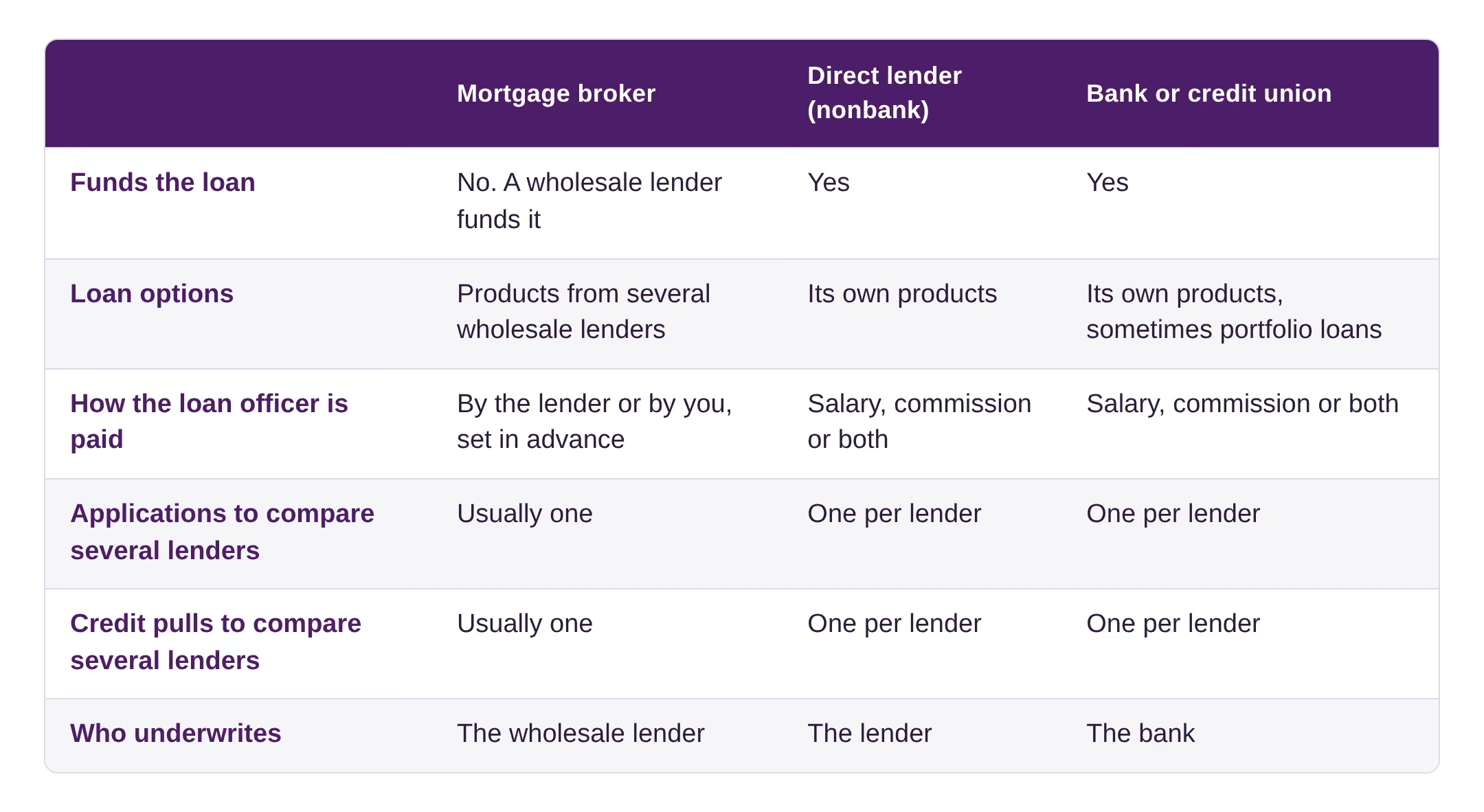
Every one of them must give you the same three-page Loan Estimate, the standard federal form that shows your rate, payment and closing costs. That form is how you compare them. See how to read a Loan Estimate.
What a Mortgage Lender Does
A lender approves your loan, funds it at closing, and sets its own prices. Lenders come in three common types.
- Banks take deposits and lend. Some keep certain loans on their own books, called portfolio loans, which can allow terms Fannie Mae and Freddie Mac would not.
- Credit unions work the same way for their members.
- Nonbank lenders (also called direct or retail lenders) only make loans. Many sell the loans after closing.
When you apply with a lender, you see that lender's rates and programs. To compare, you apply with another lender, and then another.
What a Mortgage Broker Does
A broker takes one application and shops it to several wholesale lenders. A wholesale lender is a lender that offers loans through brokers instead of directly to the public. As the CFPB puts it, a broker does not lend money; it helps you find lenders and loans.
The broker collects your documents, prices your loan with the wholesale lenders it works with, and presents the options. Once you choose, the broker submits the file to that lender. The lender underwrites it, issues the approval, and funds the loan at closing. The broker stays your contact through closing.
The main benefit is that one application can produce quotes from several lenders, usually with one credit pull. The limit is that a broker can only offer lenders it has an agreement with, so ask how many it works with.
Altgage perspective: Altgage is a mortgage broker. We can shop one application across multiple wholesale lenders and show you the options side by side. Altgage Inc., NMLS #2447252.
How Each Gets Paid
A broker is paid one of two ways on any loan, by the lender or by you, and never by both. The amount is set before your loan is priced.
Federal rules under Regulation Z control this. A loan originator's pay cannot be based on the terms of your loan, such as the interest rate. A loan originator also cannot be paid by both you and another party on the same loan. The CFPB's loan originator rule and 12 CFR 1026.36(d) cover both points. These rules apply to loan officers at banks and lenders too.
The two payment methods show up differently on your Loan Estimate:
- Borrower-paid compensation: you pay the broker directly. It appears as a fee in Section A, so you can see it and compare it.
- Lender-paid compensation: the lender pays the broker. It is not a fee you pay at closing. The lender recovers it through the rate.
Bank and retail loan officers are usually paid salary, commission or both. You do not see that pay as a line item, because the lender builds its costs into its pricing.
You pay the cost either way. With borrower-paid compensation, you can see it as a fee. For a worked example of both methods on the same loan, read how mortgage brokers and loan officers get paid.
Important distinction: Compare total cost. A visible broker fee with a lower rate can cost less over time than a loan with no broker fee and a higher rate. Section A and the rate together tell you the cost.
Do Brokers Get Better Rates?
Sometimes. The only way to know for your loan is to compare Loan Estimates.
Wholesale pricing is often different from retail pricing, because the wholesale lender does not pay for its own branches or advertising to find you. That can leave room for a competitive rate. But a bank may offer relationship pricing, a credit union may have a member special, and a large lender may be aggressive on a given day.
You may see studies claiming broker loans cost less. Before you rely on one, check who paid for it. Some are funded by wholesale lenders or trade groups with an interest in the answer.
Golden rule: Get quotes on the same day, for the same loan amount, term and lock period. Quotes taken on different days or with different specs are not comparable.
When a Lender or Bank Makes More Sense
A bank or direct lender can be the better choice in several cases.
- Relationship pricing. Some banks reduce the rate or fees if you keep a certain balance with them. Ask for the discount in writing on the Loan Estimate.
- Portfolio loans. A bank that keeps loans on its books may approve something unusual, such as a unique property, that wholesale lenders would decline.
- Construction or renovation loans. Some local banks specialize in these.
- Existing customers with simple files. If your bank's quote is competitive and you value one relationship, staying can be reasonable.
- You want the lender's own staff end to end. With a lender, the same company takes your application and underwrites it.
When a Broker Makes More Sense
A broker can help most when your file needs options or when you want several quotes without repeating the work.
- Self-employed income. Some lenders handle tax returns and business income better than others. Run your numbers: see what your deposits could qualify for with our bank statement loan calculator.
- Non-QM loans. A non-qualified mortgage is a loan outside standard agency rules, such as a bank-statement loan. See what a non-QM loan is. If you qualify on savings instead of a paycheck, try our asset depletion calculator.
- DSCR loans for investors. These qualify on the property's rent instead of your personal income. Run your numbers: check a rental's ratio with our DSCR calculator.
- Lower credit scores. Lender requirements vary, so a broker can check several lenders' minimums at once.
- Down payment assistance. Program access depends on the lender. See homebuying grants in Texas.
- You want several quotes from one application. One file, one credit pull, several lenders.
How to Choose a Mortgage Broker or a Direct Lender
Choose the one whose Loan Estimate costs you less over the time you expect to keep the loan, and whose team you trust to close on time. Four steps get you there.
- Get a Loan Estimate from each. Request one from at least one broker and one bank or direct lender on the same day, with the same loan amount, term and lock period.
- Check the license. Look up the company and the loan officer on NMLS Consumer Access, and confirm the license covers your state.
- Ask how they are paid. Ask whether compensation is paid by you or by the lender, and where it shows on the Loan Estimate.
- Ask which lenders they can access. A broker should tell you how many wholesale lenders it works with. A direct lender should tell you which of its own programs fit your file.
Then compare the rate, Section A fees, cash to close and the "In 5 Years" figure on page 3. The grading tool lines these up side by side.
How to Check a Broker or Lender
Look up any mortgage company or loan officer on NMLS Consumer Access before you send documents. It is free and takes a minute.
The Nationwide Multistate Licensing System (NMLS) gives each mortgage company and loan officer a unique ID number. On NMLS Consumer Access, you can search by name or number and see:
- Which states the company or loan officer is licensed in.
- Whether each license is active.
- Any regulatory actions taken against them.
Check that the license covers the state where the property is. Then match the NMLS number on the website and Loan Estimate to the one in the search result.
Pro tip: Ask any broker how many wholesale lenders it works with and whether it charges a broker fee. A direct answer to both is a good sign.
Frequently Asked Questions
What is a mortgage broker vs. a lender?
A lender funds your loan with its own money, approves it and sets its own prices. A mortgage broker does not fund loans. It takes your application, compares offers from the wholesale lenders it works with, and manages the process until a lender funds the loan. Both must give you a standard Loan Estimate.
Is it better to use a mortgage broker or a bank?
It depends on your loan. A bank can be competitive if you qualify for relationship pricing or need a portfolio loan. A broker can compare several lenders at once, which helps with self-employed income or lower credit. Get a Loan Estimate from each and compare them on the same day.
Do mortgage brokers charge more?
Not necessarily. A broker is paid either by the lender or by you, and federal rules bar payment from both. If you pay, the fee appears in Section A of your Loan Estimate. Compare the total cost, rate and fees together, across all your quotes.
Mortgage broker vs. loan officer: what is the difference?
A loan officer is the licensed person who takes your application. Loan officers work at banks, at direct lenders and at brokerages. A loan officer at a bank offers that bank's products. A loan officer at a brokerage can offer products from the wholesale lenders the brokerage works with.
Mortgage broker vs. direct lender: who closes faster?
Neither is faster by default. Closing speed depends on the specific lender's underwriting queue, how quickly the appraisal comes back, and how fast you send documents. Ask each one for its current average time from application to closing.
Should a first-time buyer use a mortgage broker?
It is worth getting a broker quote. Brokers can compare FHA, conventional and down payment assistance options across several lenders from one application. Get at least one quote from a bank or direct lender too, then compare the Loan Estimates.
How do I check if a mortgage broker is licensed?
Search the company and the loan officer on NMLS Consumer Access at nmlsconsumeraccess.org. It shows each license by state, whether it is active, and any regulatory actions. Make sure the license covers the state where the home is.
The Bottom Line
A lender funds your loan and offers its own products. A broker shops your application to several wholesale lenders. Both must give you a Loan Estimate, and both are bound by the same federal rules on loan officer pay.
Get quotes from at least one broker and one bank or direct lender, on the same day, with the same loan specs. Then compare the rate, Section A fees and cash to close.
Already have quotes? Grade your Loan Estimate to see how they stack up side by side. Ready to start? Get pre-approved.