First-time homebuyers
How to Shop for a Mortgage: A Step-by-Step Guide to Comparing Quotes

Oct 22, 2026
11
min read
Quick answer: To shop for a mortgage, check your credit first. Then get official Loan Estimates from several lenders or a broker within a short window, ideally 14 days. Ask each for the same loan amount, term and lock period. Compare the rate, points and lender fees side by side. Freddie Mac found one extra quote saved borrowers about $1,435 on average on a $250,000 loan.
You found the house, and your agent wants a preapproval letter by Friday. The first lender you call gives you a rate, and it sounds fine. You have no way to know whether it is a good rate until you see what other lenders would charge for the same loan.
This guide walks through how to shop around for a mortgage in seven steps, from checking your credit to choosing a lender and locking your rate. It includes a filled-in comparison of three quotes so you can see how the numbers work.
What You Compare at Each Step
Most of the work is making sure your quotes describe the same loan. Once they do, the comparison takes a few minutes.

Why Shopping Around Pays
Shopping for a mortgage saves money because lenders charge different prices for the same borrower on the same day.
Freddie Mac measured this in a 2018 study. It looked at the spread of rates lenders offered in a typical week. On a $250,000 loan, getting one additional quote saved borrowers an average of $1,435 over the life of the loan. Getting five quotes saved an average of $2,914. Eighty percent of borrowers who got one extra quote saved between $966 and $2,086 (Freddie Mac Insight, April 2018).
Those savings scale with loan size. A $500,000 loan has roughly twice the dollar savings at the same rate gap. Freddie Mac also noted that results vary: some borrowers get a good first offer, and rate gaps differ by market.
Step 1: Check Your Credit Before Lenders Do
Check your credit first because your score affects your price, and errors take time to fix.
Lenders price mortgages in credit score bands. Two borrowers with scores of 721 and 738 may pay the same price, while a borrower at 740 pays less. These pricing adjustments are explained in how mortgage rates are determined.
Fannie Mae and Freddie Mac set these steps in a grid of loan-level price adjustments (LLPAs), fees based on your credit score and down payment. See LLPAs explained for how the grid works.
Get your reports from all three bureaus at AnnualCreditReport.com. Look for:
- Accounts that aren't yours
- Late payments that were actually on time
- Credit card balances you can pay down before you apply
Checking your own credit does not affect your score. If you find an error close to your application, ask a loan officer about a rapid rescore, a lender-requested update to your credit file after a correction. See what a rapid rescore is.
Step 2: Decide What You Are Shopping For
Decide on the basic shape of the loan before you ask for quotes, because lenders can only price what you specify.
Settle these four things:
- Loan type: conventional, FHA, VA or USDA. Each has different rules and fees.
- Term: 30-year fixed, 15-year fixed, or an adjustable-rate mortgage (ARM), a loan with a fixed rate for a set period that then adjusts.
- Down payment: this sets your loan-to-value ratio (LTV), the loan amount divided by the home's value. LTV affects your price and whether you pay mortgage insurance.
- Points or no points: discount points are upfront fees that lower your rate. One point costs 1% of the loan amount. See mortgage points explained.
If you are unsure between a fixed rate and an ARM, ask for both on the same day. The gap between them tells you how the market is pricing short-term and long-term money right now.
Run your numbers: see what price range fits your income and debts with our affordability calculator.
Step 3: Get Your Quotes Inside One Credit Window
Apply with all your lenders within a short window so the credit checks count as one.
Credit scoring models treat mortgage shopping differently from opening new credit cards. According to the CFPB, multiple mortgage credit checks within a 45-day window are treated as a single inquiry. The CFPB also notes that some scoring models use a shorter window, generally 14 to 45 days depending on the model (CFPB: what happens when a lender checks my credit; CFPB: credit inquiries).
Pro tip: Keep all your applications inside 14 days. That works under every common scoring model.
Avoid applying for other credit, such as a car loan or new card, while you shop. Those inquiries count separately.
How to Shop for a Mortgage Without Hurting Your Credit
Three habits keep the credit impact small:
- Check your own reports and scores first. Your own checks do not affect your score.
- Ask each lender whether its first step uses a soft or hard credit pull. A soft pull does not affect your score.
- Submit every full application inside the same 14-day stretch, and open no other credit until you close.
Step 4: Ask for Official Loan Estimates With Matching Specs
Ask every lender for an official Loan Estimate, the standard three-page form lenders must send within three business days of your application.
A rate quoted over the phone or on a website is not enough. A Loan Estimate uses the same layout at every lender, so you can line up the numbers. It also limits how much certain fees can change before closing. Our guide on how to read a Loan Estimate walks through each page.
Golden rule: Give every lender the same loan amount, term, loan type and lock period, and get the estimates within a day or two of each other. Rates move daily, so quotes from different days are hard to compare.
Lenders need six pieces of information to issue a Loan Estimate: your name, income, Social Security number (for the credit check), the property address, an estimate of its value, and the loan amount.
Step 5: Compare Quotes Line by Line
Compare total cost over the years you expect to keep the loan, because the lowest rate is not always the cheapest loan.
Here are three quotes for the same loan.
Illustrative example, not a rate quote or offer. $400,000 loan, 30-year fixed (360 monthly payments), same borrower, same day. APRs treat the upfront lender cost, net of any lender credit, as the only finance charge.
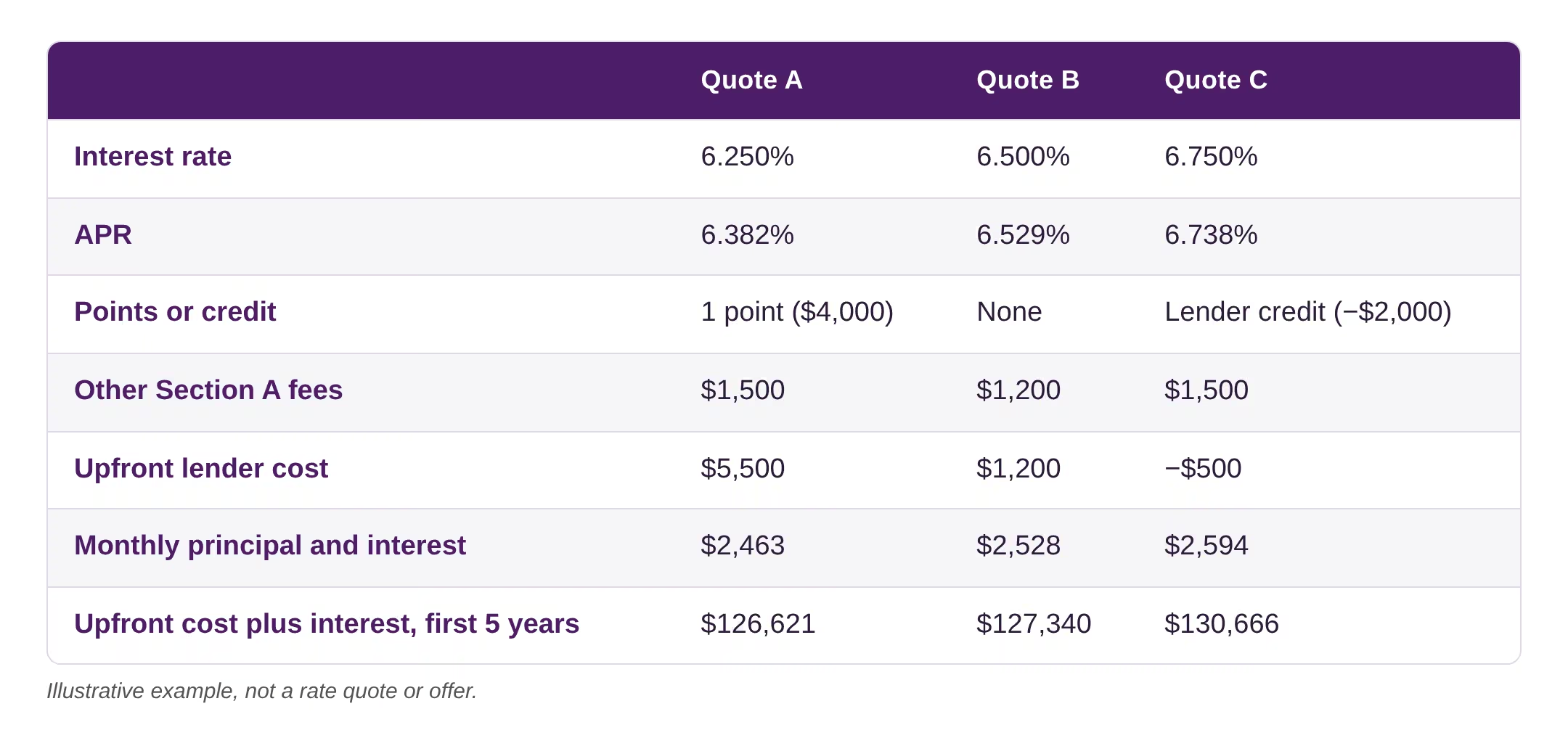
What the table shows:
- Quote C costs the least at closing. It has the highest payment, and it costs the most over five years.
- Quote B pulls ahead of Quote C after about 21 months.
- Quote A has the lowest payment, but it costs $4,300 more upfront than Quote B. It pulls ahead of B after about 52 months, and ahead of C after about 36 months.
So if you expect to sell or refinance within four years, Quote B is likely the better choice. If you expect to keep the loan longer, Quote A costs less. If cash at closing is tight, Quote C helps now and costs more later.
Run your numbers: find the break-even month for points on your own loan with our mortgage points calculator.
Your Loan Estimate does some of this math for you. Page 3 has an "In 5 Years" line that shows total payments and how much principal you paid off. It also shows the APR, the annual percentage rate. APR spreads upfront costs over the full 30-year term, so it can understate their effect if you keep the loan only a few years. See APR vs. interest rate for when to rely on each number.
Look closely at Section A on page 2. It lists origination charges, the fees the lender or broker charges to make your loan, and it is where quotes differ most. See what origination charges are.
To line up your own quotes this way, grade your Loan Estimate. Run your numbers: estimate every fee on page 2 with our closing cost calculator.
Step 6: Use Your Best Quote to Negotiate
Send your best Loan Estimate to the lender you would rather use and ask whether they can match it.
Lenders can often adjust price to win a loan, especially when you can show a written competing offer. Ask specifically:
- Can you match this rate at the same points?
- Can you lower your Section A fees?
- Where is par on this loan? Par is the rate at which you neither pay points nor receive a lender credit.
Two other questions explain a lot about a quote. Ask how your loan officer is paid, and what the quote looks like with borrower-paid compensation instead of lender-paid compensation. With lender-paid compensation, the cost is built into your rate. With borrower-paid, it appears as a fee you can see. Our guide on how loan officers get paid explains the difference.
Step 7: Lock Your Rate
Lock your rate once you have chosen a lender and have a property under contract.
A rate lock holds your rate and points for a set period, commonly 30 to 60 days. Choose a lock long enough to reach your closing date. Longer locks can cost more. If the lock expires before closing, extending it usually costs extra.
For help deciding when to lock, see should I lock my mortgage rate today.
How to Shop for a Mortgage Lender: Banks, Online Lenders, Credit Unions and Brokers
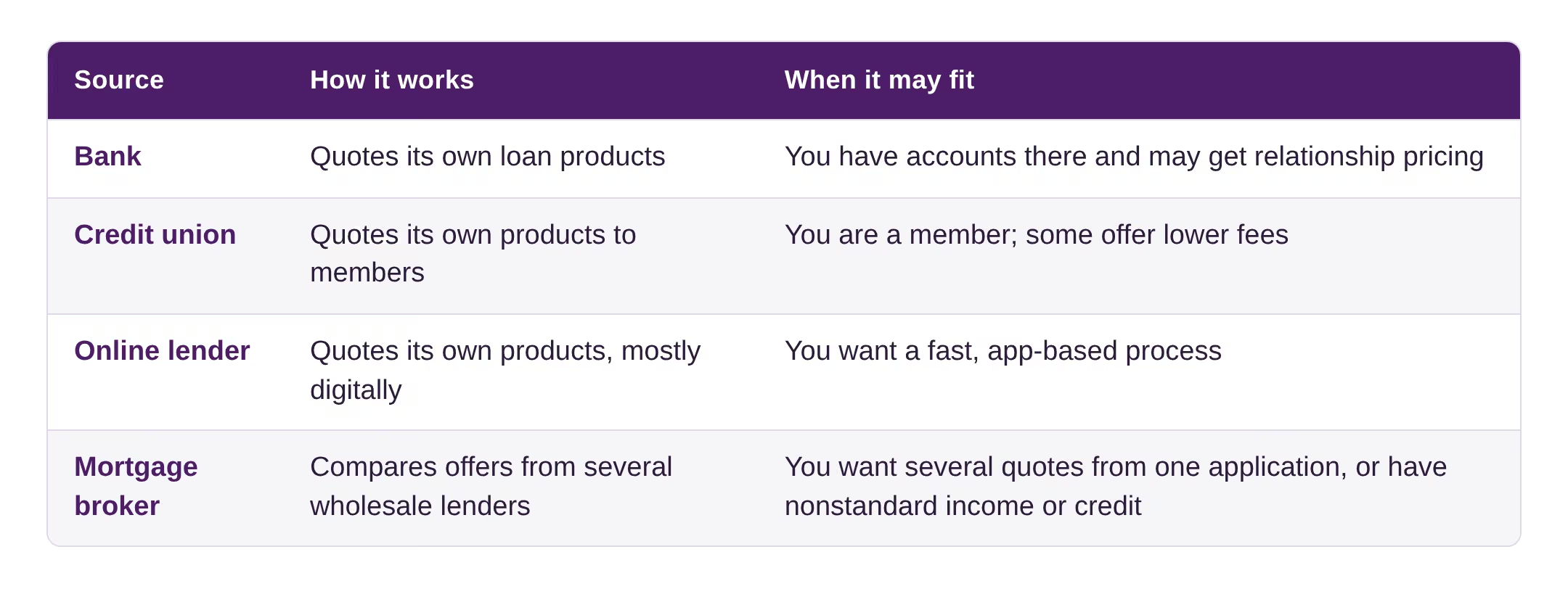
Get at least one quote from more than one kind of lender, because each has different strengths.
Altgage perspective: Altgage is a mortgage broker. We can shop multiple wholesale lenders from one application. On conventional loans, we use borrower-paid compensation, so the fee shows up on your Loan Estimate. NMLS #2447252.
For a fuller comparison, read mortgage broker vs. lender.
Frequently Asked Questions
How many mortgage quotes should I get?
Get quotes from several lenders. Freddie Mac's 2018 research found one additional quote saved borrowers about $1,435 on average over the life of a $250,000 loan, and five quotes saved about $2,914. Your savings depend on your loan size, the market and how long you keep the loan.
Does shopping for a mortgage hurt your credit?
Usually very little. The CFPB says multiple mortgage credit checks within 45 days are treated as one inquiry, and some scoring models use a window as short as 14 days. Keep all your applications within 14 days to be safe. Our guide on whether preapproval hurts your credit covers the details.
How do I shop for a mortgage without hurting my credit?
Check your own credit first, which does not affect your score. Then submit all your applications within 14 days so scoring models count them as one inquiry. Ask each lender whether its first step uses a soft or hard credit pull, and avoid opening other credit until you close.
Prequalification vs. preapproval: which do I need to compare quotes?
To compare real offers, you need a Loan Estimate, which a lender issues after you apply. A prequalification is an estimate based on what you report. A preapproval includes a credit check and a review of your documents, and sellers take it more seriously.
Mortgage broker vs. bank: which is better for shopping?
It depends on your situation. A bank quotes its own products and may offer relationship pricing. A broker can quote several wholesale lenders from one application, which saves you repeating the process. Either way, compare the Loan Estimates.
What should I compare besides the interest rate?
Compare discount points, the lender fees in Section A, the lock period, APR, total cash to close and the "In 5 Years" figure on page 3. Two quotes with the same rate can differ by thousands of dollars in fees.
Can I switch lenders after I am preapproved?
Yes. A preapproval does not commit you to a lender. You can switch until closing. A new lender will issue a new Loan Estimate and may pull your credit again, and switching late can delay your closing date.
When should I start shopping for a mortgage?
Start before you make an offer. A preapproval makes your offer stronger, and many last 60 to 90 days. See how long a preapproval lasts.
The Bottom Line
Shopping for a mortgage comes down to getting several Loan Estimates for the same loan, in a short window, and comparing their total cost over the years you plan to keep the loan. The lowest rate is not always the cheapest choice once points and fees are counted.
Check your credit first, keep your applications within 14 days, and use your best offer to negotiate. Then lock your rate for a period that reaches your closing date.
When you have your quotes, grade your Loan Estimate to see them side by side, or get pre-approved.
Related Reading
- Affordability Calculator
- Closing Cost Calculator
- Mortgage Points Calculator
- How mortgage rates are determined
- APR vs. interest rate
- How loan officers get paid
- How to read a Loan Estimate
- Grade your Loan Estimate
This article is educational and is not financial advice. Altgage Inc., NMLS #2447252, is a mortgage broker licensed in California, Colorado, Florida, Georgia, Massachusetts and Texas. This is not a commitment to lend. Rates, fees and program rules change; verify current terms with a licensed loan officer.