Mortgage Rates
LLPAs Explained: The Fannie Mae Fee Built Into Your Mortgage Rate

Oct 22, 2026
9
min read

Quick answer: An LLPA, or loan-level price adjustment, is a risk-based fee Fannie Mae and Freddie Mac charge on conventional loans. It is a percent of the loan amount, set by your credit score, down payment, occupancy, property type and loan purpose. Lenders usually build it into your interest rate, so it rarely appears as its own line on your Loan Estimate.
Two buyers apply for the same $400,000 loan on the same day. One gets a rate an eighth or a quarter of a point higher than the other. Neither sees a fee that explains the gap. In many cases the difference is an LLPA.
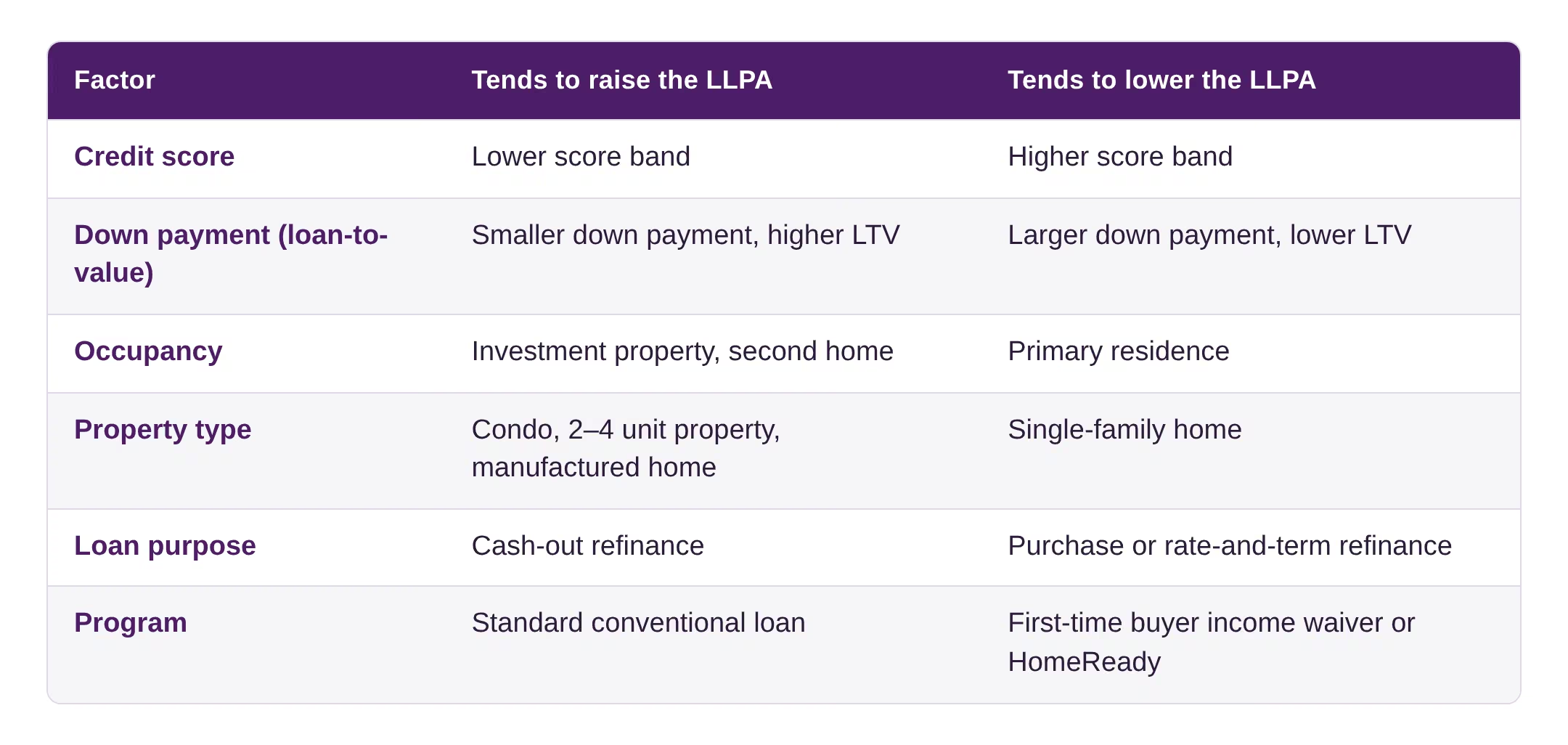
What Raises or Lowers Your LLPA
Your LLPA comes from a published grid. These are the main inputs and how they usually move the fee.
What an LLPA Is
An LLPA is an upfront fee that pays Fannie Mae or Freddie Mac for the extra risk on a loan. The agencies buy most conventional loans from lenders. They charge more for loans that are more likely to default or prepay in ways that cost them money.
The fee is a percent of the loan amount. A 1% LLPA on a $400,000 loan is $4,000. The fee is set loan by loan, which is where the name comes from.
LLPAs stack. A borrower with a lower score, a small down payment and a condo can pay one adjustment for the score and LTV, plus another for the property type. A cash-out refinance on an investment property adds still more.
Important distinction: An LLPA is not mortgage insurance. Private mortgage insurance, or PMI, protects the lender when you put less than 20% down and is billed monthly. An LLPA is a separate agency fee. A loan can carry both. Read how to avoid PMI for the insurance side.
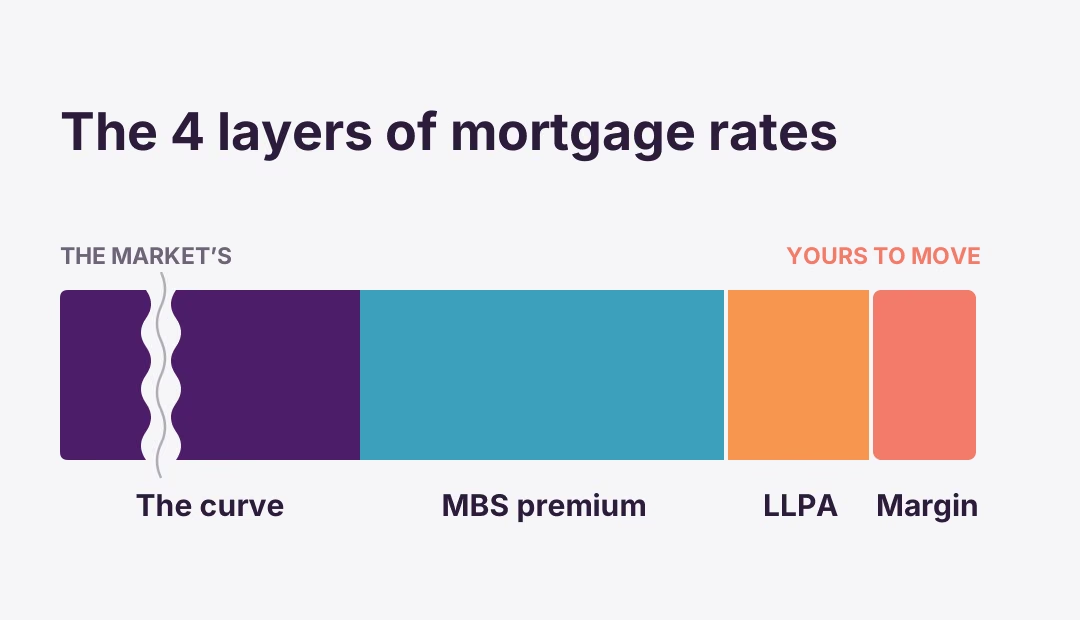
LLPAs are one of four layers that set your rate. The others are the bond market, the spread investors charge on mortgage bonds, and how your loan officer is paid. See how mortgage rates are determined for the full picture.
How an LLPA Reaches You: Through Your Rate
Most borrowers pay the LLPA through a higher interest rate, not a cash fee. The lender owes the fee to the agency when it sells the loan. It recovers that cost by pricing your rate higher.
That is why you rarely see "LLPA" on a Loan Estimate. It shows up inside the rate on page 1, the monthly payment, and the APR on page 3. You could also choose to pay it as discount points in Section A to keep the rate lower. See mortgage points explained for how that trade works. Run your numbers: compare paying points with taking the higher rate in our mortgage points calculator.
Worked example: a 1.5% LLPA on a $400,000 loan
Illustrative example, not a rate quote or offer.
Assume a $400,000, 30-year fixed loan (360 monthly payments). Assume a borrower with no LLPA would get 6.250%. A 1.5% LLPA adds $6,000 of cost.
A common rule of thumb is that each 1% of rate is worth about 4 points of price. That ratio varies by lender and by market. Under it, a 1.5-point cost becomes about 0.375% of rate. So the borrower's rate moves from 6.250% to 6.625%.
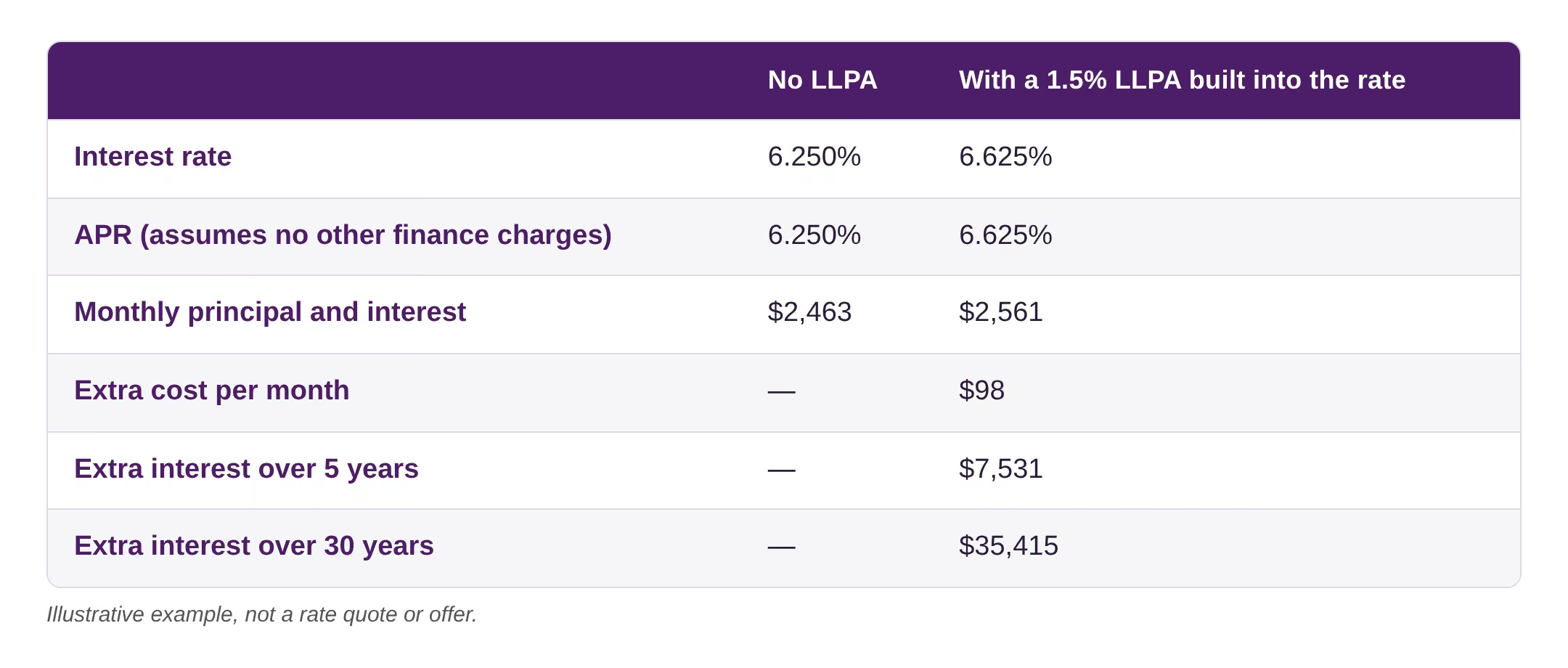
The fee was $6,000. Paid through the rate, it costs about $7,531 in extra interest over five years, and $35,415 if you keep the loan for 30 years. That is why lowering your LLPA, or getting it waived, is one of the most valuable steps you can take before you lock.
How to Read the LLPA Matrix
The matrix is a grid of credit score bands down one side and loan-to-value bands across the top. Each cell gives the fee as a percent of the loan amount. Separate tables add fees for features like cash-out, investment property, condos and multi-unit homes.
Fannie Mae publishes the current version on its Single-Family site: Fannie Mae LLPA matrix. The agencies update it from time to time, so always check the current version.
Two example cells for a purchase loan, from the matrix effective Sept 30, 2026:
- A 680 credit score with 10% down carries an LLPA of 1.5% of the loan.
- A credit score of 639 or below with 15% down carries an LLPA of 2.875%.
On a $400,000 loan, those are $6,000 and $11,500.
The grid moves in steps
The fee changes only when you cross into a new band. Within a band, every score pays the same. A 721 and a 738 land in the same band and pay the same LLPA. Crossing into the 740 band lowers it. With 20% to 25% down, a 720–739 score pays 1.250% and a 740–759 score pays 0.875%.
Pro tip: If your score sits a few points below a band edge, ask your loan officer whether paying down a card balance and doing a rapid rescore could move you up a band. A small score gain at the right spot can lower your rate for the life of the loan.
The same logic applies to down payment. Moving from 10% down to 15% down puts you in a lower LTV band, which can reduce the fee. Below 20% down, the same change also lowers mortgage insurance. Run your numbers: see how your down payment changes PMI with our PMI calculator.
Which credit score counts
Lenders selling to Fannie Mae and Freddie Mac can use classic FICO or VantageScore 4.0. Both models use the same LLPA grid. FHFA opened VantageScore 4.0 to all lenders on September 3, 2026 (The Mortgage Reports). The same borrower can score differently under each model. Ask your lender which one it uses.
Who Can Get LLPAs Waived
Some borrowers pay no LLPA at all. A waiver removes the fee entirely.
Under the Fannie Mae matrix, these loans have all LLPAs waived (certain Duty to Serve loans also qualify):
- First-time homebuyers buying a primary residence with a conventional loan, whose qualifying income is at or below 100% of the area median income (AMI), or 120% in high-cost areas.
- HomeReady loans, Fannie Mae's program for lower- and moderate-income buyers. Freddie Mac sets its own fees for its similar program, Home Possible.
Refinances, second homes and investment properties do not qualify for the first-time buyer waiver.
Qualifying income is what counts
The income test uses your qualifying income. That is the income the lender uses to approve your loan, not everything your household earns. The AMI is the median income for the county where the home is. Read what AMI is and why it matters for your mortgage for how to look up your area's figure. Run your numbers: check your income against your county's limit with our AMI calculator.
Check waiver eligibility early, before your loan is submitted. If your income is near the limit, ask your loan officer how the qualifying income will be calculated before the application goes in.
Altgage perspective: As a broker, Altgage can shop multiple wholesale lenders. Two lenders apply the same agency LLPAs, but their base pricing can differ. Comparing quotes shows you which lender prices your file best after the adjustments.
How to Lower Your LLPA
You can change three of the inputs before you apply.
- Raise your credit score into the next band. Pay card balances down, dispute errors, and avoid opening new credit while your loan is in process.
- Put more down. A lower loan-to-value can move you into a cheaper band. Compare the cost of the extra cash with the rate savings.
- Check waiver eligibility before submission. If you are a first-time buyer, look up your county's AMI and compare it with your qualifying income.
Then compare quotes on the same day, with the same loan amount and lock period. The rate difference between lenders tells you how each one is pricing the same LLPA.
Frequently Asked Questions
What is an LLPA in a mortgage?
An LLPA, or loan-level price adjustment, is a risk-based fee Fannie Mae and Freddie Mac charge on conventional loans. It is a percent of the loan amount, set by your credit score, down payment, occupancy, property type and loan purpose. Lenders usually build it into your interest rate instead of charging it as a separate cash fee.
What is the Fannie Mae LLPA matrix?
The LLPA matrix is the table Fannie Mae publishes to set these fees. It crosses credit score bands with loan-to-value bands and adds separate charges for features such as cash-out refinances, investment properties and condos. Fannie Mae updates it from time to time, so check the current version on its Single-Family website.
Can LLPAs be waived?
Yes, for some borrowers. First-time buyers whose qualifying income is at or below 100% of area median income, or 120% in high-cost areas, may have LLPAs waived. HomeReady loans also qualify. Ask your loan officer to check eligibility before your loan is submitted.
Do LLPAs apply to FHA or VA loans?
No. LLPAs are Fannie Mae and Freddie Mac fees, so they apply to conventional loans those agencies buy. FHA and VA loans have their own pricing and fees, such as FHA mortgage insurance premiums and the VA funding fee. If your credit score is lower, compare an FHA quote's total cost against a conventional quote before you choose.
Why don't I see an LLPA on my Loan Estimate?
Most lenders recover the LLPA through a higher rate instead of a separate fee. That means it shows up in your interest rate, monthly payment and APR rather than as its own line in Section A. Ask your loan officer what rate you would get without the adjustment.
How much does credit score affect my LLPA?
It can matter a lot. The matrix moves in score bands, so the fee changes only when you cross into a new band. In the current Fannie Mae matrix, a 680 score with 10% down carries a 1.5% LLPA, while a score of 639 or below with 15% down carries 2.875%.
The Bottom Line
An LLPA is a Fannie Mae or Freddie Mac fee based on your credit score, down payment and loan details. You usually pay it through a higher rate, so it is easy to miss on a Loan Estimate.
The fee moves in bands. A small change in score or down payment, or a waiver for first-time buyers under the income limit, can lower your rate for as long as you keep the loan.
Once you have quotes in hand, grade your Loan Estimate to see how they compare side by side, or get pre-approved to see where your file lands.
Related Reading
- AMI Calculator
- PMI Calculator
- Mortgage Points Calculator
- How to shop for a mortgage
- How mortgage rates are determined: the four layers
- Mortgage APR vs. interest rate
- What is AMI and does it matter for your mortgage?
- Mortgage points explained
- Grade your Loan Estimate
This article is educational and is not financial advice. Altgage Inc., NMLS #2447252, is a mortgage broker licensed in California, Colorado, Florida, Georgia, Massachusetts and Texas. This is not a commitment to lend. Rates, fees and program rules change; verify current terms with a licensed loan officer.