Quick answer: In the US, mortgage brokers and loan officers are usually paid a percentage of the loan, in one of two ways. With borrower-paid compensation, you pay it as a fee on your Loan Estimate. With lender-paid compensation, the lender pays it and recovers the cost through a higher rate. Federal rules bar pay based on your rate and bar payment from both sides.
You have two Loan Estimates for the same house. One shows $8,000 more in lender fees. The other has a higher rate and less due at closing. Often the difference between them is the loan officer's pay and where it appears.
Every mortgage includes pay for the loan officer. Either you or the lender pays it, and only one method shows the amount as a fee. This guide explains how mortgage brokers and loan officers in the United States are paid, what federal rules under Regulation Z allow, and how to work out which method costs you less.
The Two Ways at a Glance

Important distinction: The amount paid can be the same either way. Borrower-paid shows it as a fee at closing. Lender-paid puts it in your rate, and you pay it a little each month for as long as you keep the loan.
What the Rules Say
Federal rules limit how loan officers can be paid. They sit in Regulation Z, the rule that carries out the Truth in Lending Act, at 12 CFR 1026.36(d). The CFPB's loan originator rule page lists both protections.
- No pay based on loan terms. A loan officer's pay cannot be based on your interest rate or any other term of the loan, or on a stand-in for a term (1026.36(d)(1)). A loan officer cannot earn more by putting you in a higher rate.
- No pay from both sides. If you pay the loan originator directly, no one else may pay that originator on the same loan (1026.36(d)(2)). This is the ban on dual compensation.
The rules do not set how much a loan officer earns. Pay is commonly a percentage of the loan amount, set in advance in a compensation plan.
What Happened to the Yield Spread Premium?
The yield spread premium is gone in its old form. Federal Reserve rules that took effect April 1, 2011 bar paying a loan originator more for a higher rate (Federal Reserve announcement).
A yield spread premium was a payment a lender made to a mortgage broker for delivering a loan at a rate above the lender's base rate. The higher the rate, the bigger the payment. That gave a broker a reason to steer you toward a higher rate.
Regulation Z now prohibits that. The rule says no loan originator may receive, and no person may pay a loan originator, "compensation in an amount that is based on a term of a transaction" (12 CFR 1026.36(d)(1)). Your interest rate is a term of the transaction.
Two things remain:
- Lender-paid compensation. A lender can still pay the broker, but as a fixed percentage of the loan set in advance. It cannot rise with your rate.
- Lender credits. A rate above par can still produce a credit. Today that credit goes toward your closing costs or covers lender-paid compensation, and it is shown on your Loan Estimate and Closing Disclosure.
Before those forms took over on October 3, 2015, a yield spread premium was disclosed on the Good Faith Estimate and the HUD-1 settlement statement.
Lender-Paid Compensation: Built Into the Rate
With lender-paid compensation, the lender pays the loan officer and recovers that cost through the rate it offers you.
Every lender prices a loan across a range of rates. At one rate, called par, the lender neither charges you points nor gives you a credit. Below par, you pay discount points, upfront fees that lower the rate. Above par, the lender pays a premium, a credit that can cover costs.
On a lender-paid loan, the premium has to cover the loan officer's pay. That sets a floor. The lowest rate you can get without paying points is the rate whose premium equals the pay. To go below it, you pay points, even when buying the rate down would otherwise be inexpensive.
This is a legal, disclosed way to price a loan. Many borrowers choose it because it keeps cash at closing low. The cost is paid through your monthly payment for as long as you keep the loan.
Borrower-Paid Compensation: A Fee You Can See
With borrower-paid compensation, you pay the loan officer directly as part of your closing costs. It appears in Section A of your Loan Estimate with the lender's other origination charges.
Because the pay is covered separately, it does not need to be built into the rate. You can take par, pay discount points to go lower, or take a higher rate and use the credit toward closing costs. Each choice shows on the Loan Estimate.
The tradeoff is cash. You need more money at closing. On a purchase, seller credits, money the seller agrees to put toward your closing costs, can help within the limits of your loan program. Run your numbers: estimate your full cash to close with our closing cost calculator.
Altgage perspective: Altgage uses borrower-paid compensation on conventional loans. The loan officer fee appears as its own line in Section A. You see the rate and the fee separately and choose the mix that fits how long you plan to keep the loan. Altgage Inc., NMLS #2447252.
Worked Example: One $400,000 Loan Priced Both Ways
Illustrative example, not a rate quote or offer. The rates and prices below are invented to show the math. Real pricing depends on the market, your credit, your down payment and the lender.
Assume a $400,000, 30-year fixed loan (360 monthly payments) with this hypothetical pricing:

Assume the loan officer's pay is 2% of the loan, or $8,000. Each APR in the table treats the $8,000 pay, less that rate's lender credit, as the only finance charge.
- Lender-paid: the premium must cover $8,000, so the rate is 6.750% (APR 6.750%). Monthly principal and interest is $2,594. You pay no loan officer fee at closing.
- Borrower-paid: you take par at 6.250% (APR 6.442%) and pay $8,000 in Section A. Monthly principal and interest is $2,463.
Both APRs are computed with only the $8,000 fee as a finance charge, on a $400,000, 30-year fixed loan with 360 monthly payments.
Borrower-paid lowers the payment by $132 a month and costs $8,000 more at closing.
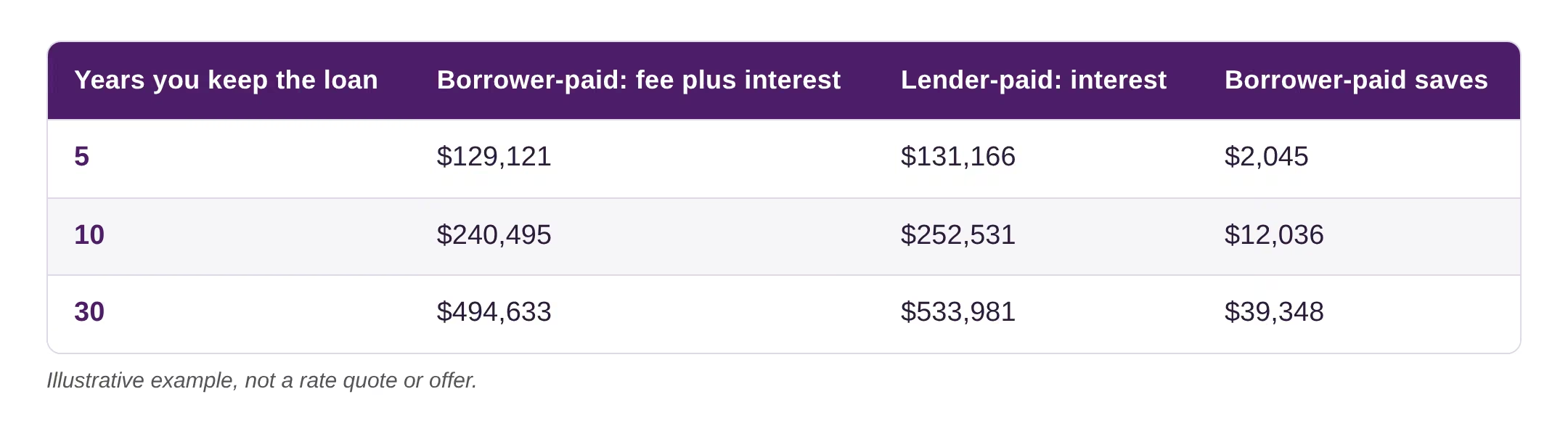
Break-even. Counting the payment difference alone, recovering $8,000 at $132 a month takes about 61 months. Counting total interest, which also reflects the faster paydown on the lower rate, borrower-paid pulls ahead at month 48.
If you sell or refinance before that point, lender-paid costs less. If you keep the loan longer, borrower-paid costs less, and the gap grows each year. Run your numbers: test the break-even on your own loan with our mortgage points calculator.
Pro tip: Page 3 of the Loan Estimate shows an "In 5 Years" figure. If you expect to move or refinance within five years, compare that line across quotes.
Which Is Cheaper for You?
Three things decide it.
- How long you will keep the loan. Past the break-even month, borrower-paid usually costs less. Before it, lender-paid usually does. If rates fall and you refinance in two years, the upfront fee buys little.
- How much cash you have. If paying the fee would drain your reserves, a higher rate may be the safer choice.
- Whether you have seller credits. Credits from the seller can reduce what you pay out of pocket at closing.
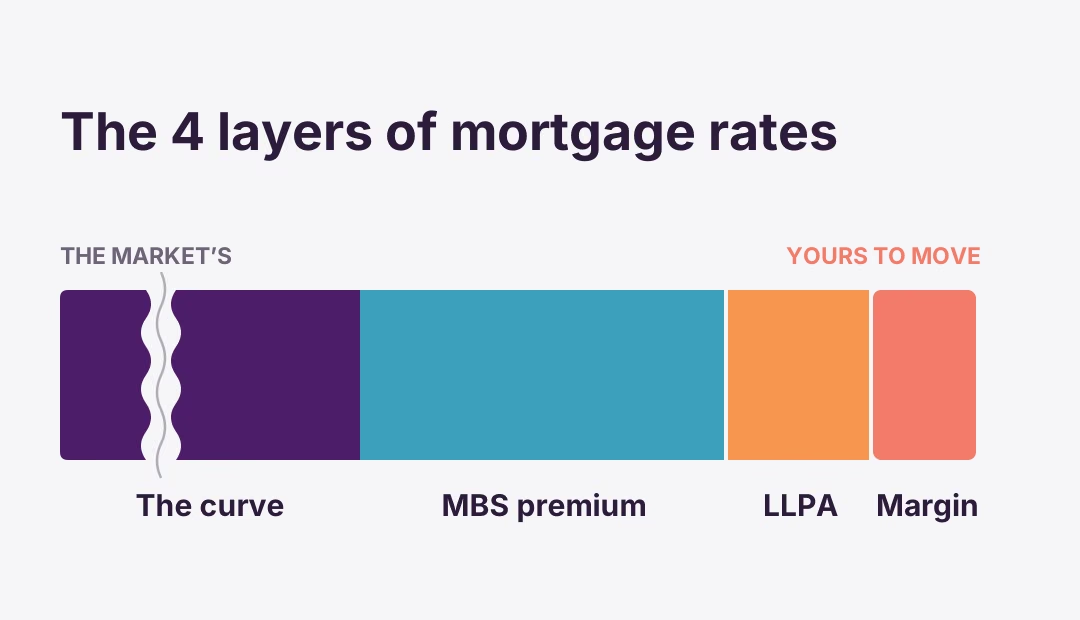
Mortgage points follow the same logic: cash today in exchange for a lower payment over time. Loan officer pay is also one of the four parts of every rate; how mortgage rates are determined covers the other three, including the risk fees explained in LLPAs explained. For the full process of collecting and comparing offers, see how to shop for a mortgage.
What Par Is, and Why to Ask for It
Par is the reference point for every number on a quote. Once you know par, you can see how much of your rate is market pricing and how much is covering costs.
Ask each lender for par on the same day, with the same lock period. Rates move daily, so quotes from different days are hard to compare.
Two Questions to Ask Any Lender
Golden rule: Ask "Where is par on this loan?" before you compare anything else.
- "Where is par on this loan?"
- "What does this look like borrower-paid instead of lender-paid?"
A lender that answers both has shown you its full pricing. Put the answers side by side in the Grade My Loan Estimate tool, which lines up rate, points, lender fees and cash to close.
Frequently Asked Questions
How do mortgage loan officers get paid?
Usually a percentage of the loan amount, set in advance in a compensation plan. Either the lender pays it and recovers the cost through your rate, or you pay it as a fee at closing. Federal rules stop the amount from changing with your interest rate or other loan terms.
Lender-paid vs. borrower-paid: which is cheaper?
It depends on how long you keep the loan. Borrower-paid usually means a lower rate and more cash at closing. Lender-paid means less cash at closing and a higher rate. Find the break-even month. If you keep the loan longer than that, borrower-paid typically costs less.
Can a loan officer earn more by giving me a higher rate?
No. Regulation Z bars loan originator pay based on the interest rate, any other term of the loan, or a stand-in for a term. What a loan officer earns on your loan cannot rise just because your rate is higher.
Where do I see loan officer pay on my Loan Estimate?
Borrower-paid compensation appears in Section A as a fee you pay. Lender-paid compensation is not charged to you, so it does not appear as your fee. Its cost is in the rate. Ask your lender which method your quote uses, and compare Section A across quotes.
What is the par rate?
The rate at which the lender neither charges discount points nor gives a lender credit. A rate below par costs points. A rate above par earns a credit, which can pay closing costs or, on a lender-paid loan, the loan officer's compensation.
Can I negotiate loan officer compensation?
Compensation plans are set in advance, and federal rules generally bar a loan officer from cutting pay on one loan to offset a pricing change, with narrow exceptions. You can still compare the visible fee across quotes and choose the lender with the lower total cost.
What is a yield spread premium?
A yield spread premium was a payment a lender made to a mortgage broker for delivering a loan at a rate above the lender's base rate. The higher the rate, the larger the payment. Federal rules now bar loan originator pay based on a loan's rate or other terms, so that form of pay is gone.
Is a yield spread premium legal?
Not in its old form. Since April 1, 2011, Regulation Z has barred paying a loan originator more for a higher rate or other loan terms. Lenders can still pay a broker a fixed percentage set in advance, and lender credits that lower your closing costs are still allowed and shown on the Loan Estimate.
The Bottom Line
With borrower-paid compensation, you see the fee and can take the par rate. With lender-paid compensation, you pay less at closing and the cost sits in your rate.
Neither method suits everyone. Work out your break-even month, compare it to how long you expect to keep the loan, and choose the version that costs less over that time.
Bring your Loan Estimates to the Grade My Loan Estimate tool to compare them side by side, or get pre-approved.
Related Reading
- Mortgage Points Calculator
- Closing Cost Calculator
- How to shop for a mortgage
- How mortgage rates are determined: the four layers
- What are origination charges?
- APR vs. interest rate
- Mortgage broker vs. lender
- Grade My Loan Estimate tool
This article is educational and is not financial advice. Altgage Inc., NMLS #2447252, is a mortgage broker licensed in California, Colorado, Florida, Georgia, Massachusetts and Texas. This is not a commitment to lend. Rates, fees and program rules change; verify current terms with a licensed loan officer.