Quick answer: Origination charges are the fees a lender or broker charges to make your loan. They appear in Section A of your Loan Estimate and can include discount points and application, underwriting and processing fees. They generally cannot rise at closing without a valid changed circumstance. They vary between lenders and are often negotiable, so compare them first.
You have two Loan Estimates on the table. The rates are close, but one quote asks for about $2,000 more in closing costs. Most of that gap usually sits in one place: Section A, the lender's own charges.
This guide explains what is in Section A, which parts buy you something, and how to compare it across quotes of different sizes. If you are still collecting quotes, start with how to shop for a mortgage.
Origination Charges at a Glance
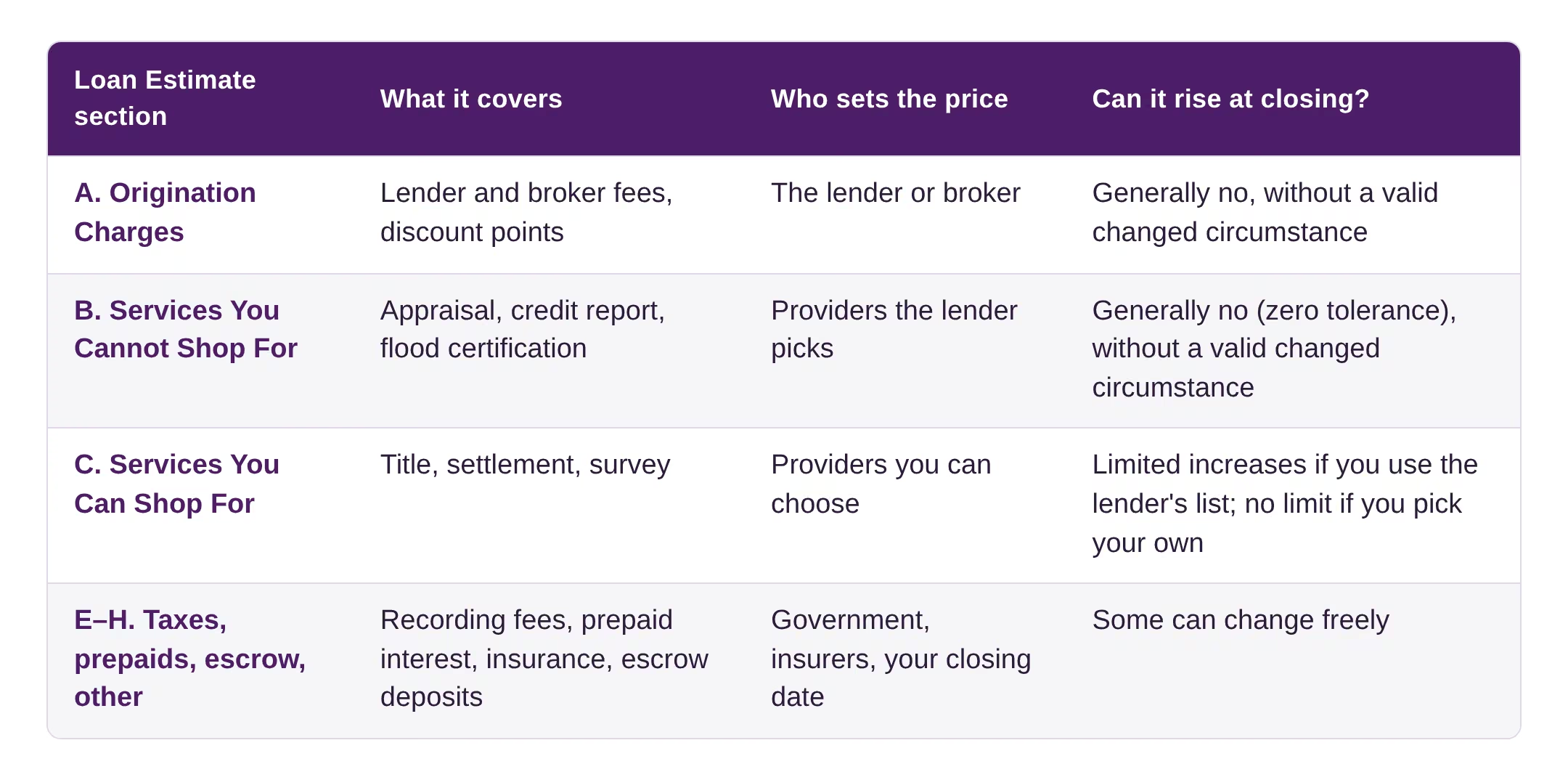
Section A is the part of your closing costs the lender or broker controls. The other sections cover third-party services, taxes and prepaid items.
What Are Origination Charges?
Origination charges are what you pay the lender or broker to make your loan. On a mortgage, they are the lender's own fees, separate from third-party costs like title or the appraisal. They show up as a single total at the top of Section A, with each fee listed below it. The CFPB describes them as the fee for making the loan, covering work like processing, underwriting and funding (CFPB: origination fees).
Because the lender sets these fees itself, they vary more from one lender to another than most other closing costs. Third-party costs such as an appraisal tend to be similar wherever you go.
What Is in Section A
Section A can hold several line items. Not every lender uses every one, and names vary
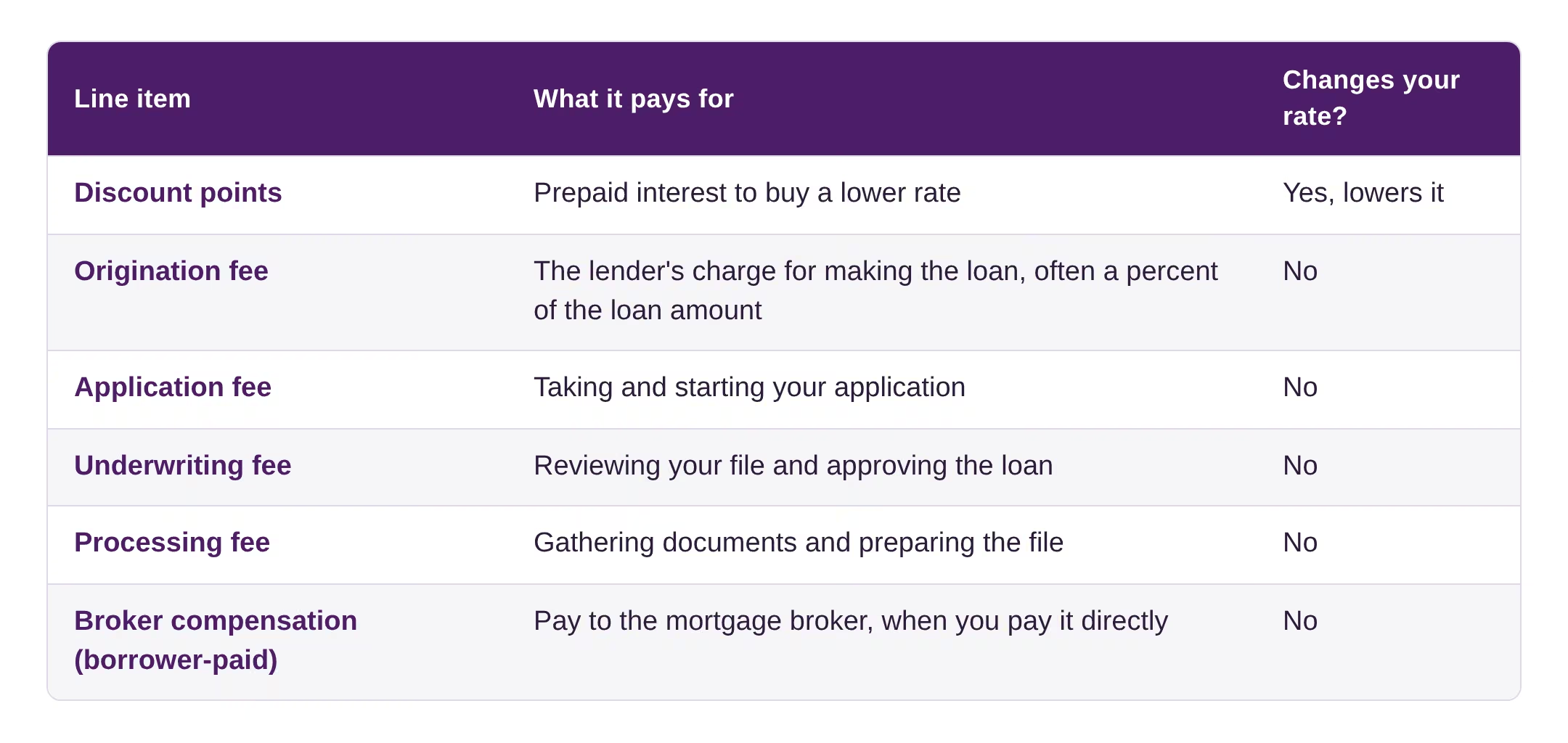
Borrower-paid broker compensation appears in Section A because you pay it yourself. When the lender pays the broker instead, that cost is built into the rate rather than listed here. See how loan officers get paid for how the two approaches compare.
Altgage perspective: Altgage uses borrower-paid compensation on conventional loans, so the broker's pay is a line in Section A you can read and compare. Altgage is a broker and can shop multiple wholesale lenders for the same loan.
Origination Fee vs. Discount Points
An origination fee pays for making the loan. Discount points buy a lower rate. Both sit in Section A, but only points change your monthly payment. For a closer look at the two side by side, see origination fee vs. discount points.
Discount points are prepaid interest. One point equals 1% of the loan amount. You pay them at closing in exchange for a lower interest rate for the life of the loan. Whether points pay off depends on how long you keep the loan. Our guide to mortgage points explained walks through the break-even math. Run your numbers: find your break-even month with our mortgage points calculator.
Important distinction: When you compare Section A across quotes, separate points from fees. A quote with a higher Section A total may simply include points that buy a lower rate. A quote with high fees and no points buys you nothing for the extra cost.
How Section A Differs From Sections B and C
Section A is the lender's own pricing. Sections B and C are payments to other companies.
Section B lists services the lender requires and chooses the provider for, such as the appraisal and credit report. Section C lists services you are allowed to shop for, such as title and settlement. You can lower Section C by choosing your own providers. You lower Section A by comparing lenders or negotiating with the one you prefer.
How Much Are Origination Charges?
There is no standard amount. Each lender sets its own fees and decides whether to charge a flat fee, a percent of the loan, or both.
That makes dollar totals hard to compare when loan sizes differ. Convert each quote's Section A total to a percent of the loan amount, then compare the percents. Run your numbers: see where Section A fits in your total closing costs with our closing cost calculator.
How to Compare Section A Across Quotes
Compare Section A in three steps: pull out discount points, total the remaining fees, and divide by the loan amount.
Illustrative example, not a rate quote or offer.
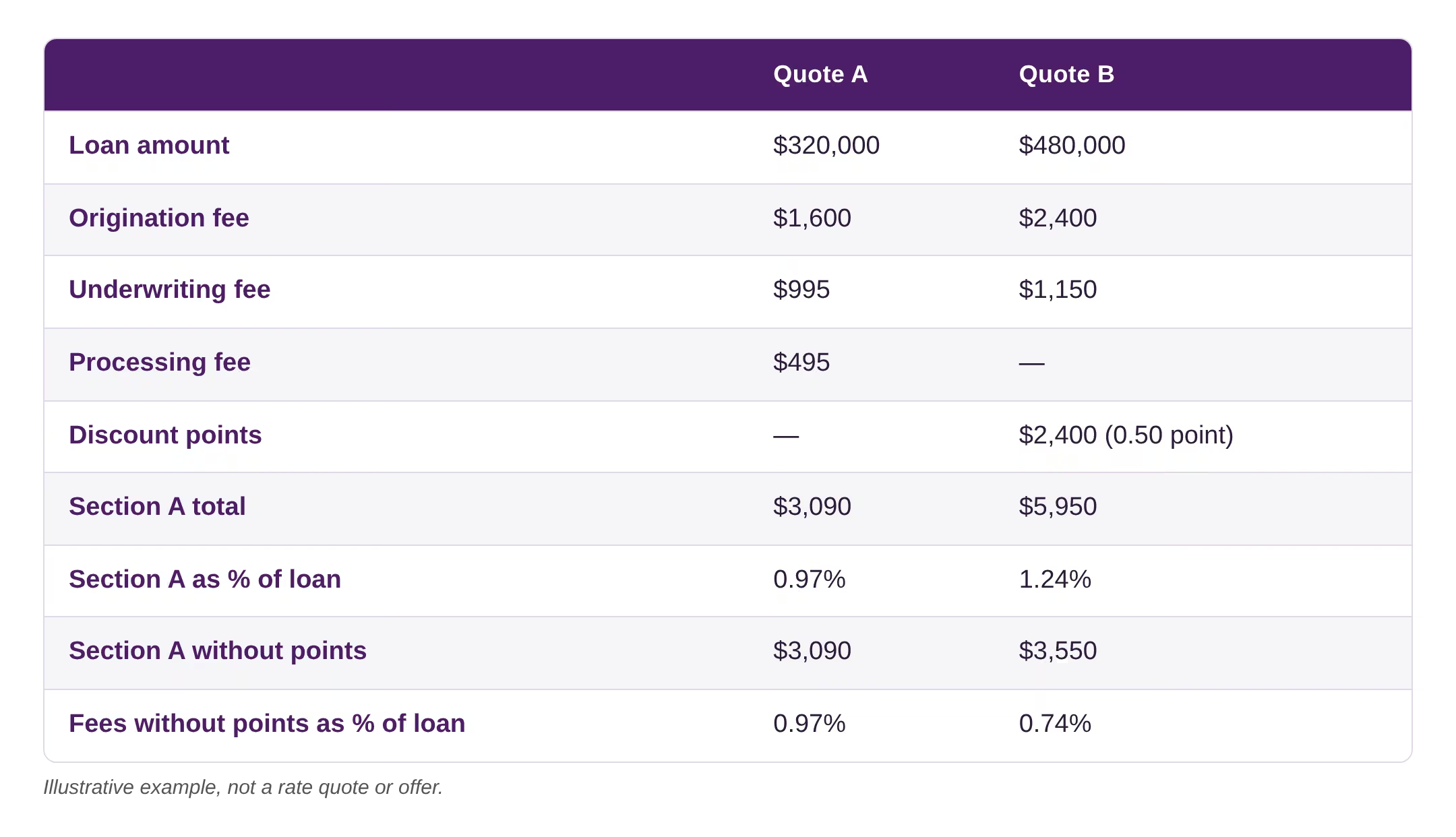
On dollars alone, Quote B looks almost twice as expensive. Once you remove the points, which buy Quote B a lower rate, its fees are a smaller share of the loan than Quote A's. The next question is whether the lower rate is worth $2,400 over the time you expect to keep the loan.
Pro tip: Run this comparison on Loan Estimates issued the same day, for the same loan amount, term and lock period. Pricing moves daily, so quotes from different days are hard to compare.
You can do this by hand, or grade your Loan Estimate with the Altgage compare tool, which lines up Section A next to the rate and cash to close.
Why Section A Generally Cannot Go Up at Closing
Federal rules generally hold Section A fixed once you have your Loan Estimate. Fees paid to the lender or broker fall in a zero-tolerance category, which means they cannot increase at closing unless there is a valid changed circumstance (12 CFR 1026.19(e)(3)).
A changed circumstance is a real change to the loan or your situation, such as a different loan amount, a lower appraised value, or a change you request. When one happens, the lender can issue a revised Loan Estimate. Your Closing Disclosure, which you receive before closing, shows the final numbers. Compare it line by line with your Loan Estimate. If a Section A fee went up and nobody explained why, ask.
If your rate is not yet locked, discount points can change with the market, because the price of a given rate changes daily. Locking your rate sets the points. If points or credits change when you lock, the lender must send a revised Loan Estimate within three business days. See should you lock your rate today.
Can You Negotiate or Avoid Origination Charges?
You can often negotiate origination charges, and a competing Loan Estimate helps. Lenders set their own fees, so they have room to match.
There are three common approaches:
- Ask for a match. Send your preferred lender a lower Loan Estimate for the same loan and ask whether they can match its Section A.
- Ask for a lender credit. A lender credit reduces your closing costs in exchange for a slightly higher rate. It appears as a negative number in the Loan Estimate's closing cost totals.
- Compare fee-waived offers carefully. A lender that waives its fees may charge a higher rate to make up the cost. Compare the total cost over the years you expect to keep the loan, not the fees alone.
Golden rule: Judge Section A together with the rate. Lower fees with a higher rate can cost more over time, and the reverse can be true too.
Frequently Asked Questions
Are mortgage origination fees negotiable?
Often, yes. Each lender sets its own origination fees, so a competing Loan Estimate with lower Section A charges gives you room to ask for a match or a lender credit. Compare quotes issued on the same day for the same loan amount, term and lock period, so the comparison is fair.
Origination fee vs. discount points: what is the difference?
An origination fee pays the lender for making the loan and does not change your rate. Discount points are prepaid interest that lower your rate for the life of the loan. Both appear in Section A of the Loan Estimate, so separate them before comparing quotes.
Can origination charges change after I get my Loan Estimate?
Generally no. Fees paid to the lender or broker fall under a zero-tolerance rule and cannot increase at closing without a valid changed circumstance, such as a change in loan amount. Discount points can move with the market until your rate is locked.
Is a no-origination-fee mortgage cheaper?
Not always. Lenders that waive their fees often charge a higher rate to recover the cost. Compare the total cost, including interest, over the number of years you expect to keep the loan. A short stay tends to favor lower fees; a long stay can favor a lower rate.
Can I roll origination fees into my loan?
On many refinances you can add closing costs to the loan balance. On a purchase, you usually cannot, though a lender credit or seller credit can offset them. Our guide covers the options: can you roll closing costs into a mortgage.
Are loan origination charges deductible?
Discount points may be. The IRS treats points as prepaid interest, usually deducted over the life of the loan. Points on a loan to buy or build your main home may be deductible in the year paid if you itemize and meet the conditions in IRS Topic 504. Appraisal, notary and note preparation fees are not deductible as interest. Ask a tax professional.
The Bottom Line
Section A is the part of your closing costs the lender controls, so it is where quotes differ most. Pull out discount points, total the remaining fees, and compare them as a percent of the loan amount.
Then weigh Section A against the rate. A lower fee total is only better if the rate and your time in the loan support it. Once you have two or three Loan Estimates, grade your Loan Estimate to see them side by side, or get pre-approved.
Related Reading
- Closing Cost Calculator
- Mortgage Points Calculator
- How to shop for a mortgage
- How to read a Loan Estimate
- APR vs. interest rate
- How loan officers get paid
- Mortgage points explained
- Grade your Loan Estimate
This article is educational and is not financial advice. Altgage Inc., NMLS #2447252, is a mortgage broker licensed in California, Colorado, Florida, Georgia, Massachusetts and Texas. This is not a commitment to lend. Rates, fees and program rules change; verify current terms with a licensed loan officer.