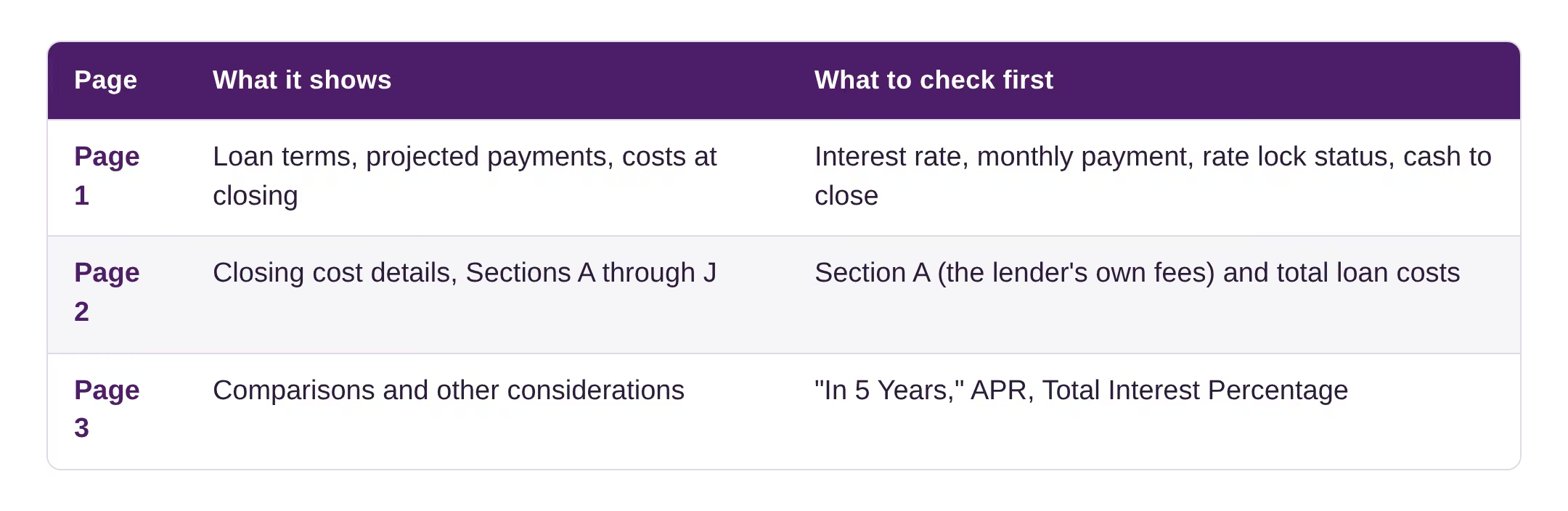
Quick answer: A Loan Estimate is a three-page form a lender must send within three business days of your application. Page 1 shows the rate, monthly payment and cash to close. Page 2 itemizes closing costs, with the lender's own fees in Section A. Page 3 shows the APR and five-year cost. To compare lenders, line up those three spots.
You applied with two lenders and now have two PDFs that look almost the same. The rates are close, the totals differ by a few thousand dollars, and you can't tell which offer is better. This guide walks through the form page by page, then shows you how to compare two of them line by line.
What Appears on a Loan Estimate
Every Loan Estimate uses the same federal layout, so the same number sits in the same place on every lender's form. The top of page 1 names the lender and lists the loan term, purpose, product and loan type. Page 3 lists the lender's and loan officer's names and NMLS IDs, plus other considerations such as late-payment terms and whether the lender intends to service the loan.
What a Loan Estimate Is and When You Get It
A Loan Estimate is a standard three-page disclosure of a loan's rate, payment and closing costs. A lender must deliver it no later than three business days after it receives your application.
For this rule, you have applied once you give the lender six pieces of information:
- Your name
- Your income
- Your Social Security number
- The property address
- An estimate of the property's value
- The loan amount you want
The rules in the next section limit what a lender can ask of you before then. The lender must honor the estimate's pricing if you say you intend to proceed within 10 business days.
Pro tip: Give every lender the same six items on the same day. Quotes priced on different days can differ because the market moved.
What a Lender Can't Do Before Giving You a Loan Estimate
Federal rules put three limits on a lender until you have the Loan Estimate in hand. They come from Regulation Z, under the rule known as TRID (the TILA-RESPA Integrated Disclosure rule), at 12 CFR 1026.19(e)(2).
- No fees except a credit report fee. Before you receive the Loan Estimate and tell the lender you intend to proceed, the only fee it may charge is a reasonable fee for pulling your credit report. Application, appraisal, underwriting and lock fees must wait.
- No document demands. A lender cannot require you to send pay stubs, bank statements or other documents that verify your information as a condition of giving you a Loan Estimate. You may send them if you choose, but the estimate cannot be held back until you do.
- Early written estimates must say so. If a lender gives you a written estimate of terms before the official Loan Estimate, it must say at the top: "Your actual rate, payment, and costs could be higher. Get an official Loan Estimate before choosing a loan." It also cannot be made to look like a Loan Estimate.
If a lender asks for an application fee or a stack of documents before sending a Loan Estimate, ask why. You are entitled to the estimate first.
Page 1: Loan Terms, Projected Payments, Costs at Closing
Page 1 is the summary. Start here to confirm you are comparing the same loan.
Loan Terms lists the loan amount, interest rate and monthly principal and interest. Next to each is a column asking "Can this amount increase after closing?" On a fixed-rate loan, each answer should be "No." On an adjustable-rate mortgage, the rate and payment rows will say "Yes" and show how high they can go.
The same section flags a prepayment penalty (a fee for paying the loan off early) and a balloon payment (a large lump sum due at the end). For most conventional and FHA loans, both should say "No."
Projected Payments shows your full monthly payment: principal and interest, mortgage insurance, and estimated escrow for property taxes and homeowners insurance. Escrow estimates vary by lender. A lower monthly payment on one form may come from a lower tax estimate. Run your numbers: check the mortgage insurance line with our PMI calculator.
Costs at Closing shows two totals: estimated closing costs and estimated cash to close.
Rate lock status and expiration
At the top of page 1, the form says whether your rate is locked and, if so, until when. If it says "No," the rate can still change. A rate lock is the lender's commitment to hold a rate for a set period. Compare quotes only when both are locked for the same period, or both are unlocked and priced the same day. Our guide on whether to lock your rate today covers timing.
The rate on page 1 is the result of several pricing layers, including bond markets and risk fees tied to your credit score and down payment, called loan-level price adjustments. See how mortgage rates are determined for what drives that number.
Page 2: Closing Cost Details
Page 2 splits closing costs into loan costs (Sections A through D) and other costs (Sections E through J). The lender controls Section A. Most of the rest comes from third parties or depends on your property.
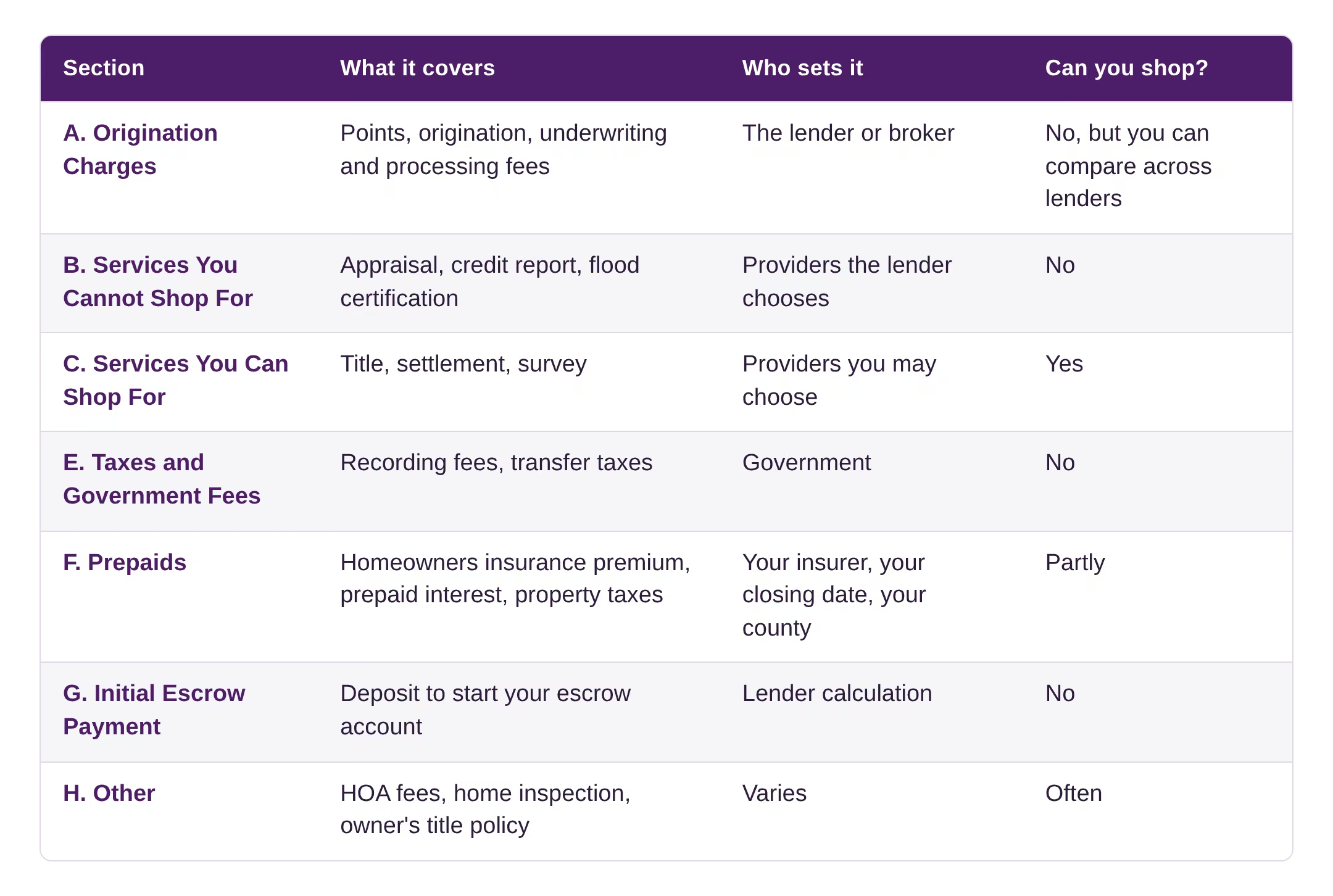
Sections D, I and J are totals. D is total loan costs (A + B + C), I is total other costs (E + F + G + H), and J is total closing costs (D + I). Run your numbers: estimate Sections A through J for your own purchase with our closing cost calculator.
Sections A, B and C: loan costs
Section A is the best place to compare lenders, because it holds only the lender's or broker's own charges. It may include discount points, which are prepaid interest you pay to lower your rate. A low rate with a large Section A is not the same offer as a slightly higher rate with a small Section A. If a broker is paid by you, that compensation also appears in Section A. Read how loan officers get paid to see why that line exists on some estimates and not others, and what origination charges are for a fee-by-fee breakdown.
Sections B and C are mostly third-party fees. They should be similar across lenders in the same area. A large gap in Section C usually means one lender's title estimate is out of date.
Sections E through H: other costs
These depend on your property, county and closing date. One lender estimating prepaid interest for 25 days and another for 5 days will show very different Section F totals for the same loan. Do not treat a lower Section F as a cheaper lender.
Calculating Cash to Close
The bottom of page 2 adds your closing costs, subtracts your deposit and any seller credits, and adds your down payment. Cash to close is the amount you bring to closing. It changes with your purchase contract, so use it to plan your cash.
Page 3: Comparisons
Page 3 is built for comparing offers. It has three lines.
- In 5 Years shows the total you will have paid in principal, interest, mortgage insurance and loan costs over the first five years, and how much principal you will have paid off (12 CFR 1026.37(l)).
- Annual Percentage Rate (APR) is the yearly cost of the loan including certain fees, spread over the full loan term.
- Total Interest Percentage (TIP) is the total interest paid over the life of the loan, as a percentage of the loan amount.
The "In 5 Years" line matters most if you might sell or refinance within a few years. APR assumes you keep the loan for its entire term, so it spreads upfront costs over 30 years. If you leave after five, those costs fall on far fewer payments. We explain this in detail in APR vs. interest rate. Run your numbers: see how much principal you pay off in five years with our amortization calculator.
Important distinction: APR spreads costs over the full 30-year term. The "In 5 Years" line shows the cost over the first five years. Look at both.
Which Fees Can Change Before Closing
Federal rules limit how much some Loan Estimate fees can rise by closing. These limits are called tolerances (12 CFR 1026.19(e)(3)). They apply unless there is a valid changed circumstance, such as a change in your loan amount, income or the appraised value, in which case the lender may issue a revised estimate.
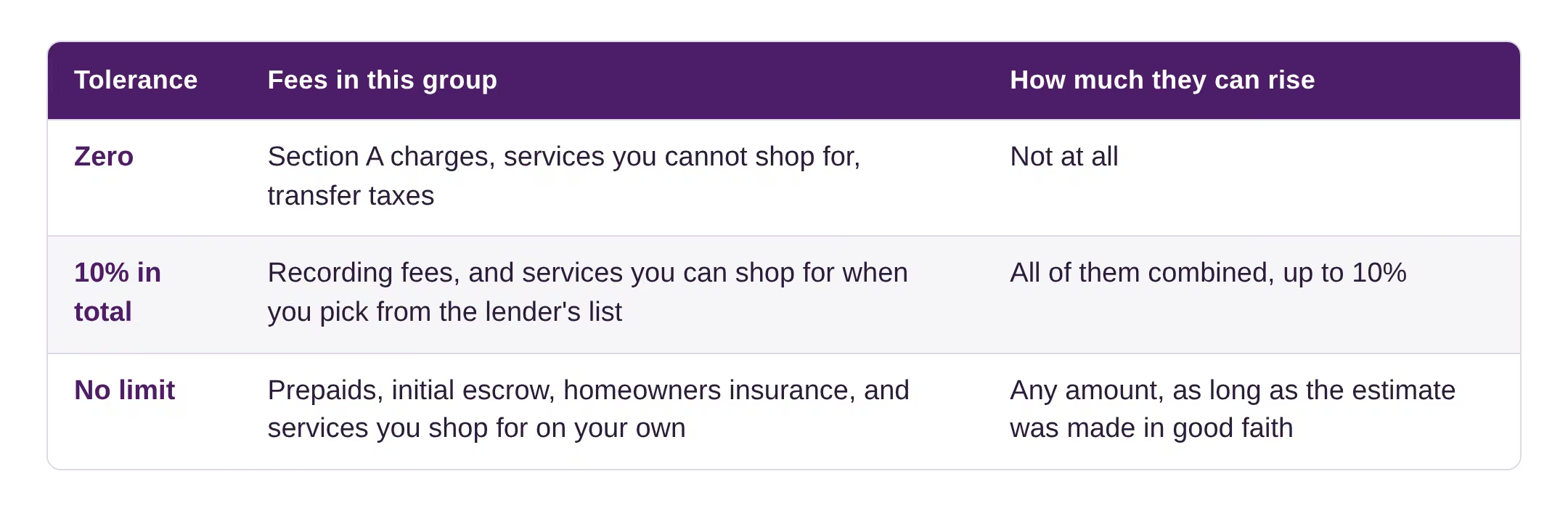
Section A fees fall in the zero-tolerance group, so they cannot rise at closing without a valid changed circumstance.
How to Compare Two Loan Estimates
Check that the loans match first. Then compare five lines.
Step 0: confirm the loans are the same. Same loan amount, loan type, term and lock period, and estimates issued within a day or two of each other. If any of these differ, the comparison is not valid.
Then compare:
- Interest rate (page 1): the rate that sets your payment.
- Section A total (page 2): the lender's own fees, including any points.
- Total loan costs, Section D (page 2): Sections A, B and C together.
- Cash to close (page 2): only after confirming both use the same purchase price and down payment.
- In 5 Years (page 3): total paid and principal paid off over five years.
Golden rule: Compare estimates with the same loan amount, term and lock period, issued within a day or two of each other.
An example
Illustrative example, not a rate quote or offer. Two lenders quote a $400,000, 30-year fixed loan (360 monthly payments). Sections B and C total $3,500 on both. APRs treat only Section A as finance charges.
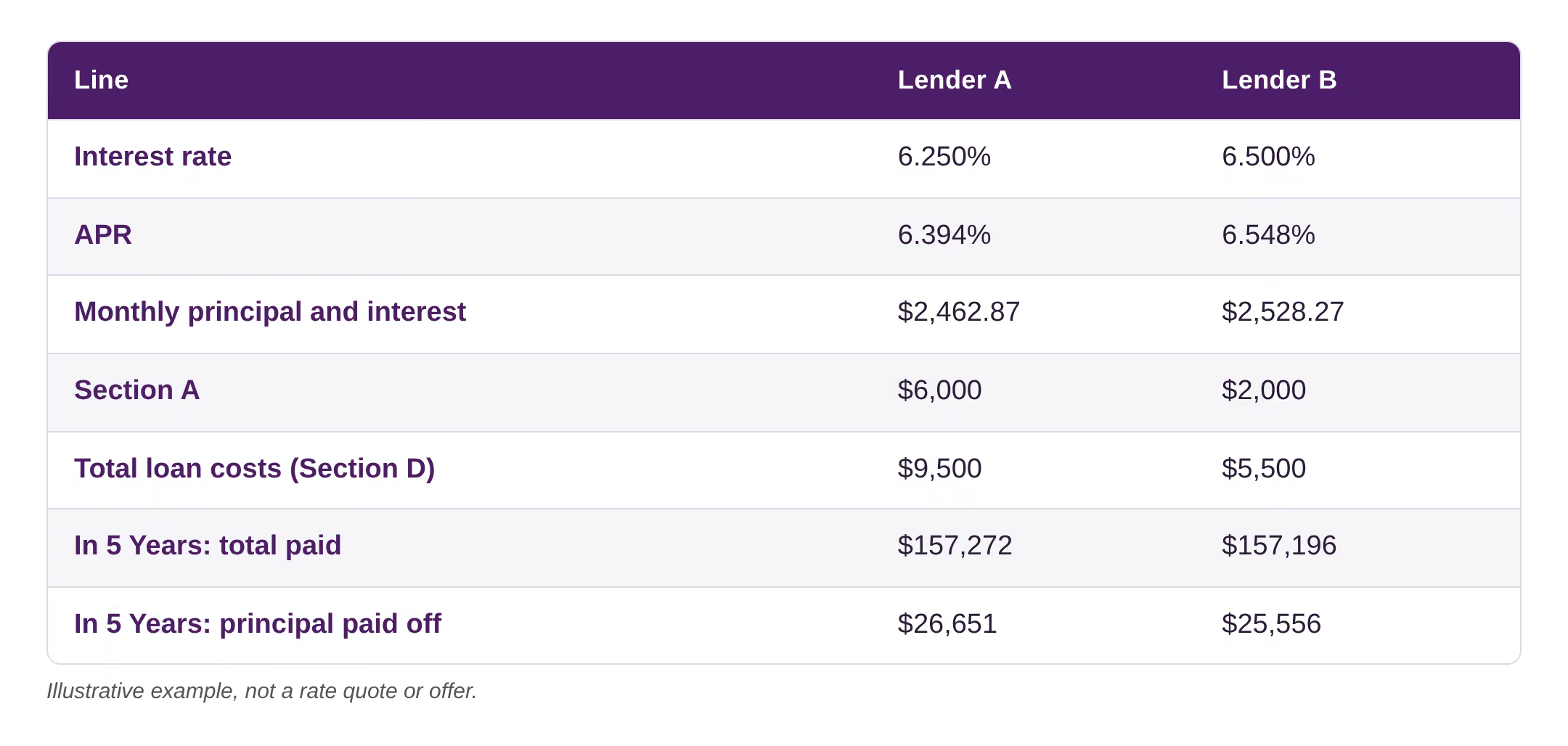
Lender B looks cheaper at closing by $4,000. Over five years, total payments are nearly equal, but Lender A pays off $1,095 more principal. Subtracting principal from total paid, Lender A costs about $1,019 less over five years. In this example the two cross at about four years. If you expect to move or refinance sooner than that, Lender B costs less. If you expect to stay longer, Lender A does.
You can line up your own estimates this way with our Loan Estimate grading tool.
Altgage perspective: As a broker, Altgage can price the same loan with several wholesale lenders from one application. That makes it easier to compare Section A and the "In 5 Years" line across lenders without filling out multiple applications.
Loan Estimate vs. Closing Disclosure
The Loan Estimate comes early. The Closing Disclosure shows your final terms and must reach you at least three business days before closing (12 CFR 1026.19(f)(1)(ii)). It uses the same layout, so you can compare them line by line. Check that Section A has not risen and that any change in the rate or loan amount has an explanation.
Frequently Asked Questions
What is a Loan Estimate?
A Loan Estimate is a standard three-page form showing a loan's interest rate, monthly payment and closing costs. Lenders must provide it within three business days of receiving your application. Because every lender uses the same layout, you can compare offers line by line.
What appears on a Loan Estimate?
Page 1 shows the loan terms, interest rate, monthly payment, rate lock status and cash to close. Page 2 itemizes closing costs in Sections A through J, with the lender's own fees in Section A. Page 3 shows the In 5 Years cost, APR, Total Interest Percentage and the lender's and loan officer's NMLS IDs.
Loan Estimate vs. Closing Disclosure: what is the difference?
The Loan Estimate arrives after you apply and shows estimated terms. The Closing Disclosure shows final terms and must arrive at least three business days before closing. Compare the two to catch changes, especially in the rate and Section A.
Loan Estimate vs. preapproval letter: which matters for comparing?
The Loan Estimate. A preapproval letter tells a seller you can likely borrow a certain amount. It does not show your rate or fees, so it cannot tell you which lender is cheaper.
Is a Loan Estimate free?
Mostly. Before you receive the Loan Estimate and say you want to proceed, a lender may charge only a reasonable fee for your credit report. Other fees, such as the appraisal, come after you choose to move forward.
What can a lender not do before providing a Loan Estimate?
Before you receive the Loan Estimate and say you intend to proceed, a lender cannot charge any fee except a reasonable credit report fee. It also cannot require documents that verify your income or assets as a condition of giving you the estimate. Any earlier written estimate must state that your actual costs could be higher.
Which Loan Estimate fees can change?
The lender's own fees in Section A generally cannot rise. Recording fees and services you shop for from the lender's list can rise up to 10% in total. Prepaid interest, insurance, escrow and services you choose yourself can change without a set limit.
Does getting a Loan Estimate commit me to the lender?
No. A Loan Estimate is a disclosure, not a contract. Nothing commits you until you tell the lender you intend to proceed, and you can still choose another lender before closing.
How do I compare Loan Estimates from different lenders?
First confirm the loan amount, term and lock period match. Then compare the interest rate, Section A, total loan costs, cash to close and the "In 5 Years" line on page 3. The grading tool lines these up for you.
The Bottom Line
A Loan Estimate puts every lender's offer on the same form. Page 1 confirms the loan terms, page 2 shows the lender's own fees in Section A, and page 3 shows what the loan costs over five years and over its full life.
Compare matching loans, priced on the same day. Look hardest at Section A and the "In 5 Years" line, because those show the differences that come from the lender rather than from your property or closing date.
Have two estimates in hand? Grade your Loan Estimate to see them side by side. Still shopping? Get pre-approved.