Mortgage Rates
How Mortgage Rates Are Determined: The Four Layers in Your Rate

Oct 22, 2026
12
min read
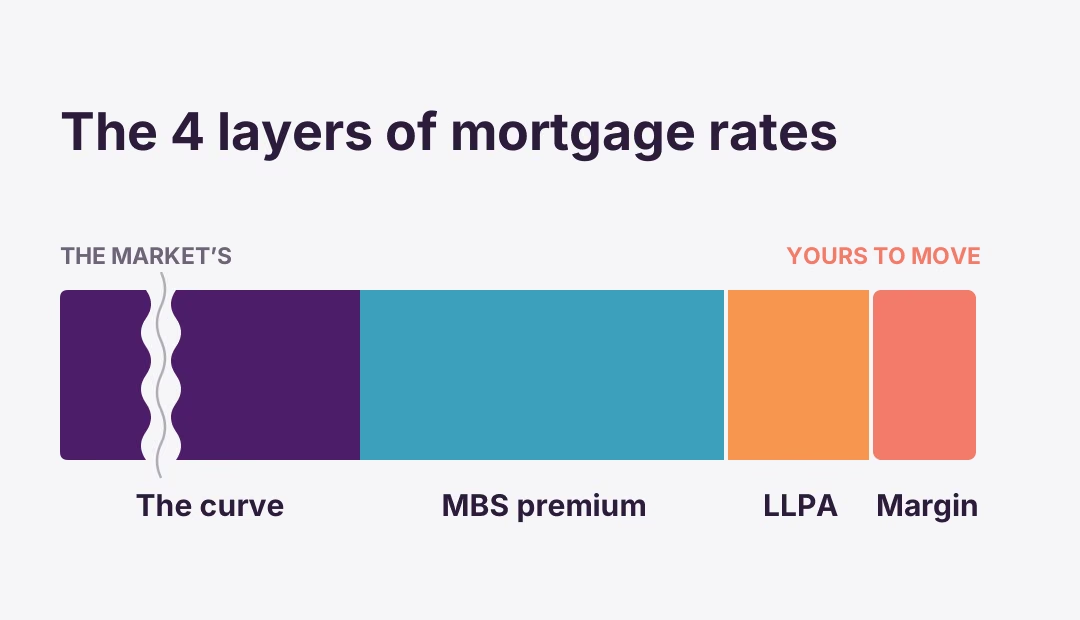
Quick answer: Four layers set your mortgage rate. The bond market sets the base: long-term yields for fixed loans, short-term rates for ARMs. Investors add a spread for buying mortgage bonds. Fannie Mae and Freddie Mac add risk fees for your credit score and down payment. Then your loan officer's pay is added, as a fee or built into the rate.
Your quoted rate is often higher than the advertised rate. The reason is how mortgage interest rates are determined: your rate is built in four layers, and a quote usually shows only the total.
This guide walks through each layer, shows which ones you can change, and ends with two questions that surface the rest.
The Four Layers at a Glance
Two of the four layers are set by markets. The other two depend on your file and on how your loan officer is paid, and those are the two you can change.
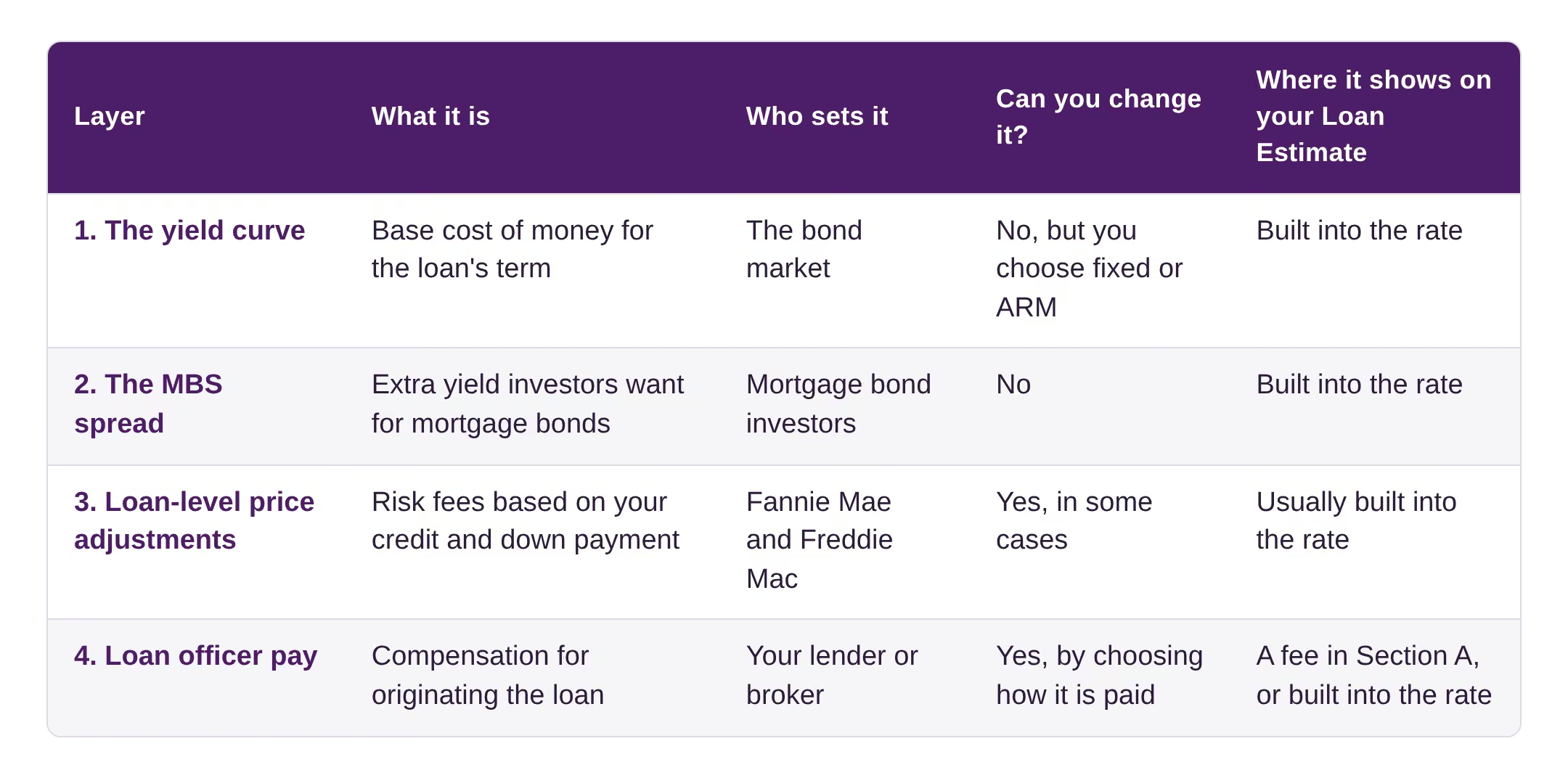
Important distinction: Three of the four layers are usually paid through your rate, not in cash. That means they don't appear as separate charges on your Loan Estimate. A quote can look normal and still carry thousands of dollars of cost inside the rate.
Layer 1: The Yield Curve
The bond market sets 30-year mortgage rates. Fixed-rate loans and adjustable-rate loans follow different parts of it.
The yield curve is the set of interest rates on bonds of different lengths, from a few months to 30 years. A 30-year fixed mortgage is priced off the long end of the curve. An adjustable-rate mortgage (ARM) is priced off the short end, and after its fixed period it resets based on SOFR, a short-term benchmark rate. Short-term rates do follow the Fed closely.
This means the choice between a fixed loan and an ARM depends on the shape of the curve on the day you lock:
- When short-term rates sit above long-term rates, an ARM's starting rate is barely lower than a fixed rate. You take on reset risk for little discount.
- When the curve steepens and short-term rates fall below long-term rates, the ARM discount grows.
Pro tip: Ask for a fixed quote and an ARM quote on the same day, from the same file. If the ARM discount is small, you take on reset risk for little savings.
How are fixed mortgage rates determined?
A fixed rate is priced from the market for mortgage-backed securities, which tracks long-term Treasury yields, mainly the 10-year. Investors expect many 30-year loans to be paid off early through a sale or refinance, so they price them against a shorter bond than the loan's term.
Lenders turn those bond prices into a daily rate sheet, and prices can change during the day as the market moves. Layers 2 to 4 are then added on top. Your fixed rate is set when you lock and stays the same for the life of the loan.
Layer 2: The MBS Spread
Most loans are bundled into mortgage-backed securities (MBS) and sold to investors. The price investors pay for those bonds largely sets the rate lenders can offer you.
Investors want more yield on mortgage bonds than on Treasury bonds. Borrowers can refinance or pay off early, which cuts off the investor's interest income at the worst time. The extra yield investors demand for that risk is the spread.
Historically, the gap between the 30-year fixed mortgage rate and the 10-year Treasury yield has averaged about 1.7 to 1.8 percentage points, according to HousingWire. In recent years it has often run above 2 points. Rate volatility is one reason.
No borrower can negotiate the spread. It is part of every lender's pricing on a given day. It's worth knowing about because it explains why mortgage rates sometimes move differently from the Treasury yields you see in the news.
Layer 3: Loan-Level Price Adjustments
This layer often costs the most, and it is rarely itemized.
A loan-level price adjustment (LLPA) is an upfront risk fee that Fannie Mae and Freddie Mac charge on conventional loans. It is a percentage of the loan amount, set by your credit score, your loan-to-value ratio (LTV) (the loan amount divided by the home's value), property type, occupancy and other features. The adjustments stack, so several small ones can add up to a large one.
For the grid, the waiver rules and how to read the matrix, see our full LLPA guide.
What LLPAs cost
The fees can be large. Two examples from the Fannie Mae LLPA matrix (effective Sept 30, 2026), for a purchase loan:
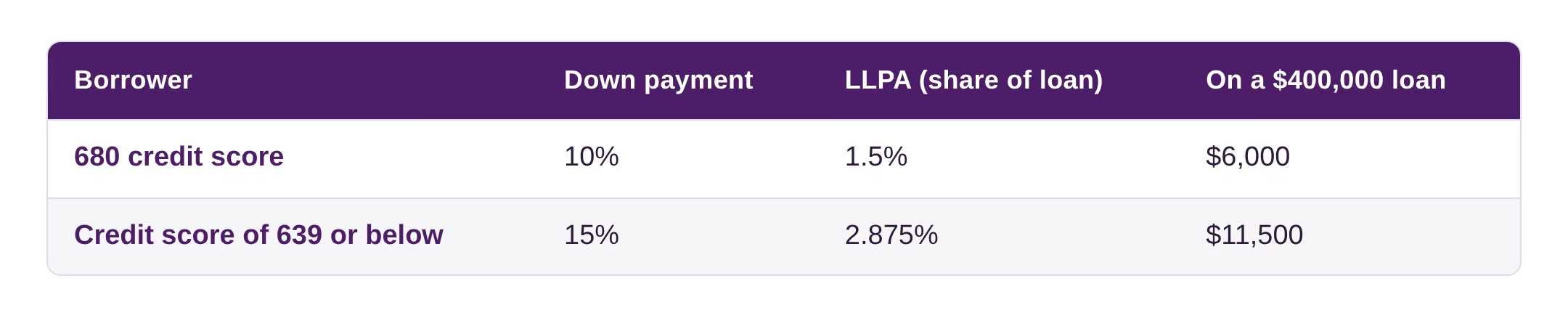
Illustrative example, not a rate quote or offer.
You almost never pay this as a check at closing. Lenders usually absorb it into your rate, so a 1.5% fee shows up as a rate somewhat higher for the life of the loan. The Loan Estimate shows only the rate, so the fee stays invisible.
The grid moves in bands
LLPAs change in steps. Credit scores are grouped into bands, and everyone in a band pays the same fee. A 721 and a 738 pay the same adjustment. At 740 the fee steps down. With 20% to 25% down, for example, a 720–739 score pays 1.250% and a 740–759 score pays 0.875%.
That makes a few points of credit score worth a lot when you are near a band edge. The fastest ways to move a score:
- Pay down credit card balances before the lender pulls your credit.
- Dispute errors on your credit report.
- Avoid opening new credit while your loan is in process.
If your score is close to the next band, ask your loan officer about a rapid rescore, which can update your score after you pay down a balance.
Pro tip: Ask your loan officer which credit band you are in and how many points it would take to reach the next one. If the answer is under 20 points, it may be worth waiting a few weeks.
Two credit score models
On September 3, 2026, the Federal Housing Finance Agency allowed every lender selling loans to Fannie Mae and Freddie Mac to use VantageScore 4.0, according to The Mortgage Reports. Classic FICO is still accepted. Each lender chooses which model to use. Both models now use the same LLPA grid.
The same borrower can get different scores from the two models. Because LLPAs depend on your score band, the model your lender uses can change your fee. Ask which model produced your score.
Getting LLPAs waived
Some borrowers pay no LLPAs at all.
Area median income (AMI) is the middle income for the area where the home is located. Fannie Mae and Freddie Mac publish AMI limits each year. The 2026 limits took effect on June 13, 2026, and most areas increased over 2025, according to Freddie Mac.
For how AMI is set and how to look up the limit for an address, see what AMI is and why it matters for your mortgage. Run your numbers: check your county's limit with our AMI calculator.
The Fannie Mae matrix waives LLPAs for these loans (certain Duty to Serve loans also qualify):
- First-time buyers with income at or under 100% of AMI (120% in high-cost areas). Only one borrower needs to be a first-time buyer. A first-time buyer generally means someone who has not owned a primary residence in the past three years.
- HomeReady loans (Fannie Mae). HomeReady is generally for borrowers with income at or under 80% of AMI, and it has no first-time buyer requirement. Freddie Mac sets its own fees for its similar program, Home Possible.
Two details trip people up:
- The test counts the income of the people on the loan, not everyone in the household.
- The limit is not adjusted for family size. Use the agencies' AMI lookup tools, not HUD's family-size income tables.
In expensive metro areas, 100% of AMI can be well into six figures. Check the limit for your area even if you think your income is too high.
The test uses qualifying income
The AMI limit applies to your qualifying income: the income the lender uses to approve the loan. It does not have to include everything you earn.
If your debt-to-income ratio works without bonus or overtime income, that income does not need to be documented on the file. If one borrower's income qualifies alone, a co-borrower's income may not need to be used, and that person can still be on title.
This is a choice about which income you document to qualify. Decide it early and check eligibility before your loan is submitted. Talk it through with your loan officer before you apply.
Pro tip: Ask your loan officer to check whether you may qualify for an LLPA waiver before the loan is submitted to underwriting. Then the choice of which income to use can still affect the waiver.
Layer 4: Who Pays Your Loan Officer
Your loan officer is paid for originating your loan, either by you or by the lender. With borrower-paid compensation, you pay it as a fee listed on your Loan Estimate. With lender-paid compensation, the lender pays it and recovers the cost through your rate, the same way it absorbs an LLPA. Both are legal and disclosed, but only one shows up as a number you can compare. For the full breakdown, read how loan officers get paid.
Which Layers You Can Change
You can't change Layers 1 and 2. You can often change Layers 3 and 4.
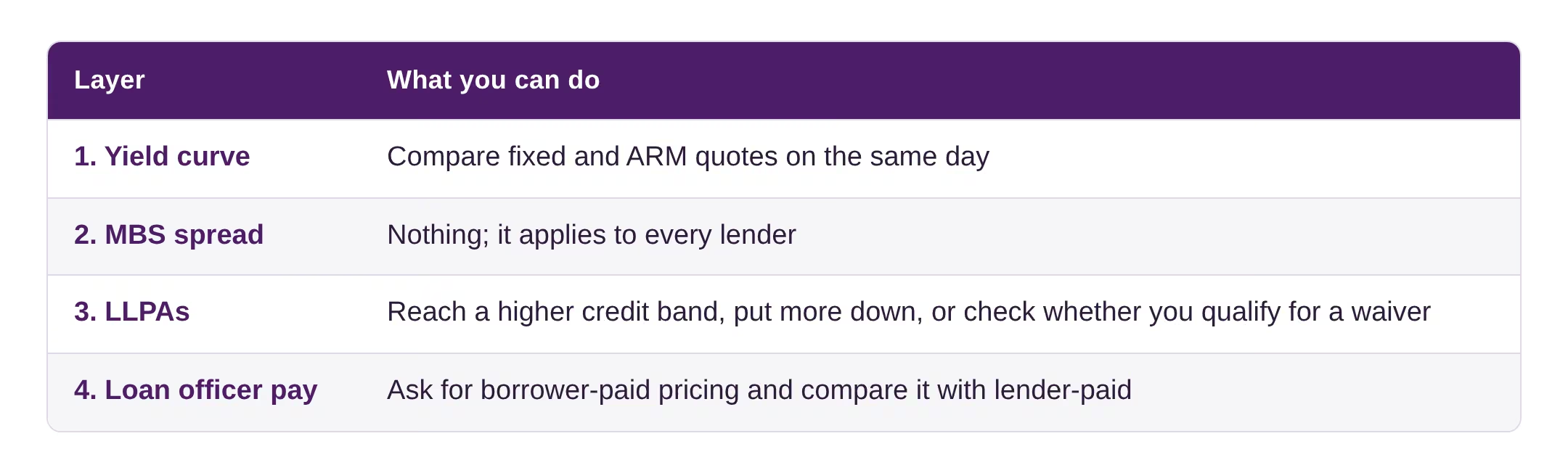
Preparation helps most with Layer 3. A few weeks of credit work or a check of the AMI limits can lower your rate.
You can also trade cash for a lower rate with discount points. Our guide to mortgage points explains how points work and when they pay off. Run your numbers: see the break-even month on your own loan with our mortgage points calculator.
Two Questions to Ask Any Lender
These two questions bring Layers 3 and 4 into view:
- "Where is par on this loan?" The par rate is the rate at which you pay no discount points and receive no lender credit. Knowing it tells you how much of your quote is the market and how much is added on top.
- "What does this look like borrower-paid instead of lender-paid?" The answer shows how much of your rate is covering your loan officer's pay.
A lender who answers both has shown you how your rate was built. If a lender won't answer, keep shopping. Our guide on how to shop for a mortgage covers how to collect comparable quotes.
Golden rule: Compare quotes from the same day, for the same loan amount, term and lock period. Otherwise the market layers move underneath you and the comparison doesn't mean much.
Frequently Asked Questions
Does the Fed set mortgage rates?
Not directly. The Fed sets the overnight federal funds rate. A 30-year fixed mortgage follows longer-term bond yields and mortgage-bond prices. ARMs track short-term rates more closely and reset based on SOFR after their fixed period, so Fed moves affect them more.
What is a loan-level price adjustment?
An LLPA is an upfront risk fee Fannie Mae and Freddie Mac charge on conventional loans. It depends on your credit score, loan-to-value ratio, occupancy and property type. Lenders usually recover it through a higher rate, so it rarely appears as its own line on your Loan Estimate.
How can I avoid LLPAs?
First-time buyers with qualifying income at or under 100% of area median income (120% in high-cost areas) may have LLPAs waived. HomeReady borrowers may also qualify. Otherwise, moving into a higher credit score band or putting more money down lowers the fee.
Why is my rate higher than the advertised rate?
Advertised rates usually assume a high credit score, at least 20% down, a single-family primary home, and sometimes discount points. Your own risk fees and your loan officer's pay are added on top of that base.
ARM vs. fixed: which is cheaper?
It depends on the yield curve on the day you lock. When short-term rates sit above long-term rates, an ARM's starting discount is small. When the curve steepens, the discount grows. Ask for both quotes on the same day from the same file.
How are fixed mortgage rates determined?
A fixed rate is priced from mortgage-bond prices, which follow long-term Treasury yields, mainly the 10-year. Lenders then add the risk fees tied to your credit score and down payment, plus loan officer pay. The rate is set when you lock and stays the same for the life of the loan.
Does it matter whether my lender uses FICO or VantageScore?
It can. Lenders selling to Fannie Mae and Freddie Mac may use either model, and the same borrower can score differently on each. Because LLPAs depend on score bands, ask your lender which model produced your score.
The Bottom Line
Your rate is built from four layers. The yield curve and the MBS spread are set by the market, and every lender faces the same ones on a given day. Risk fees and loan officer pay depend on your file and your lender, and they are usually hidden inside the rate.
You can often lower those two layers. Check your credit band, check whether your income falls under the AMI limit, and ask where par is and what borrower-paid pricing looks like.
When you have a quote, grade your Loan Estimate to see how it compares and where the cost sits, or get pre-approved.
Related Reading
- AMI Calculator
- Mortgage Points Calculator
- How to Shop for a Mortgage and Compare Quotes
- How Loan Officers Get Paid
- APR vs. Interest Rate: Which Number Should You Compare?
- Should I Lock My Mortgage Rate Today?
- Grade your Loan Estimate
This article is educational and is not financial advice. Altgage Inc., NMLS #2447252, is a mortgage broker licensed in California, Colorado, Florida, Georgia, Massachusetts and Texas. This is not a commitment to lend. Rates, fees and program rules change; verify current terms with a licensed loan officer.